






Raèld Audio

The Raèld Journal · The sound

The sound of something expensive.

Rich low end, silk on top, depth you can walk into. What it takes to make a plugin sound like the best room in the building, and why every Raèld plugin does.

Raèld Echo

There is a moment in every great session when the mix stops sounding like a mix. The kick has weight but no boom. The vocal is close enough to touch, and the cymbals shimmer instead of hiss. Nothing is fighting for room. It just sounds expensive.

That moment used to need a rack of hardware and the room built around it. Raèld Audio exists to put it inside your DAW: tools that add richness where you ask for it and keep everything else pristine. Here is what that sounds like, plugin by plugin, and the engineering that makes it real.

I

Warmth

Weight, glue and glow

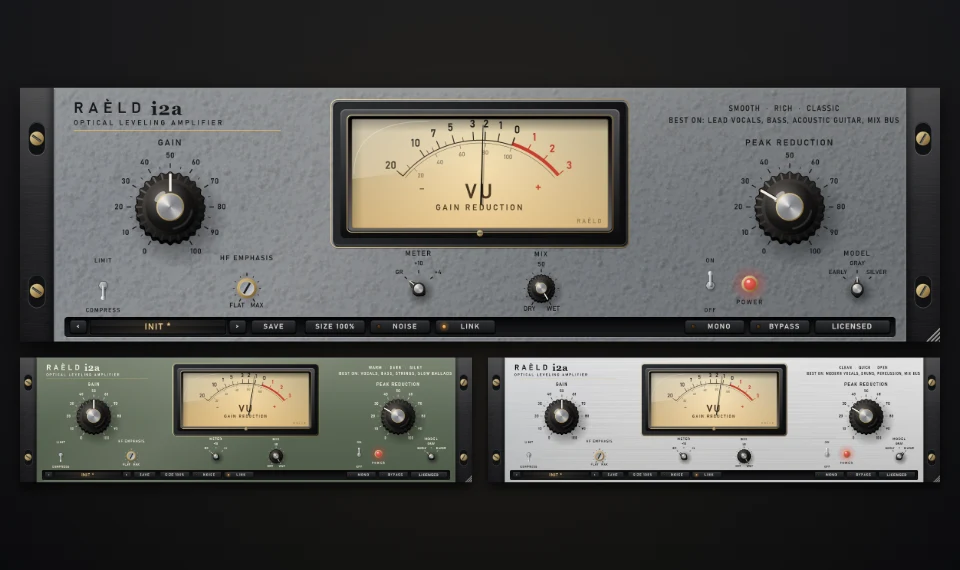
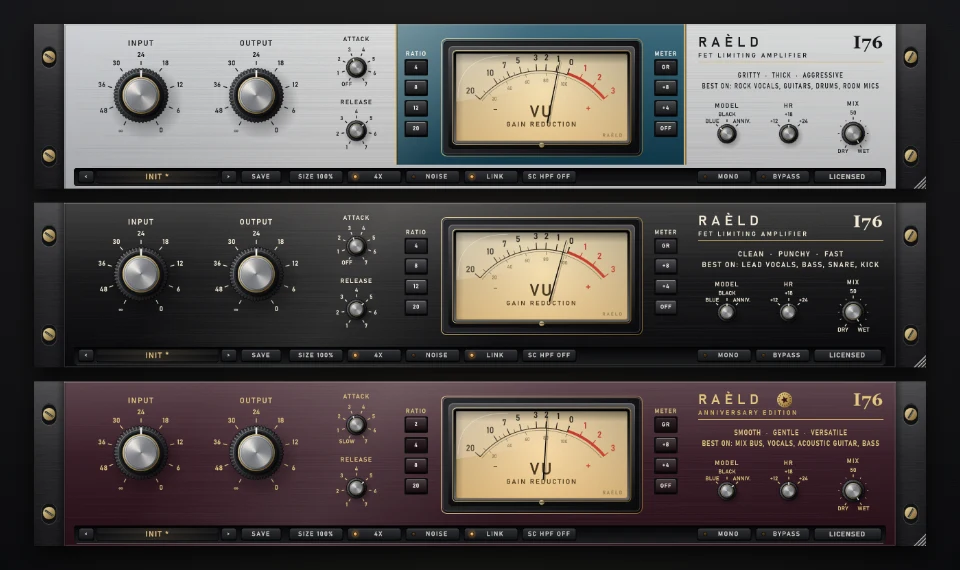
Warmth is the first thing people hear in old hardware, and the first thing most plugins fake. Raèld models the circuit itself. In Raèld I76 the signal travels through an input transformer with real flux saturation, a FET gain stage and a class-A line amp before the output transformer, so it grows thicker and more forward the harder you lean on it. Raèld i2a levels through a modelled light panel and photocell that remember how hard they have worked, which is why its release breathes the way a vocal wants it to.

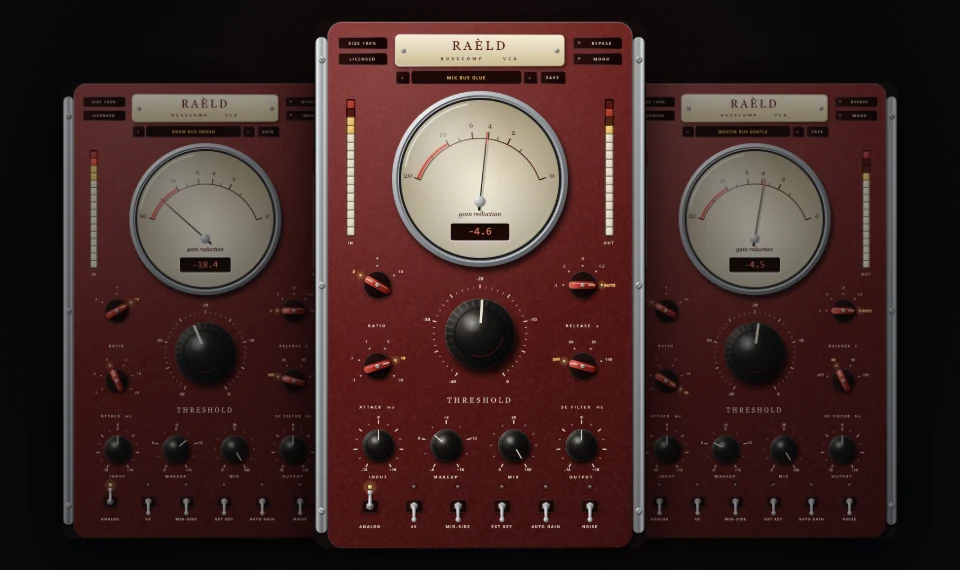
On the mix bus, Raèld Busscomp glues a song together with a feed-forward VCA, and its ANALOG stage adds the harmonics of the VCA, the output stage and the transformer, with the bass saturating first, exactly like the console it is modelled on.

  • Calibrated like hardware. 0 VU sits at −18 dBFS, so the knobs bite where your ears expect.
  • Harmonics without grit. Every stage that bends the signal is oversampled, and the tests check that aliasing stays out.
  • Three voices each. I76 and i2a each carry three models of their circuit, crossfading as you switch.

“Richness is what you add. Luxury is what you leave alone.”

Raèld Audio · Studio notes

II

Air

Silk on top, never glass

Brightness is easy. Air is hard. Push the top of most digital EQs and the curve bunches up near the top of the spectrum and the sound turns glassy. Raèld EQ matches the analog curve its bands are drawn from to within about 0.15 dB, right up to 20 kHz at 44.1 kHz, so a high shelf opens a vocal the way a great console does: wide, soft and expensive.

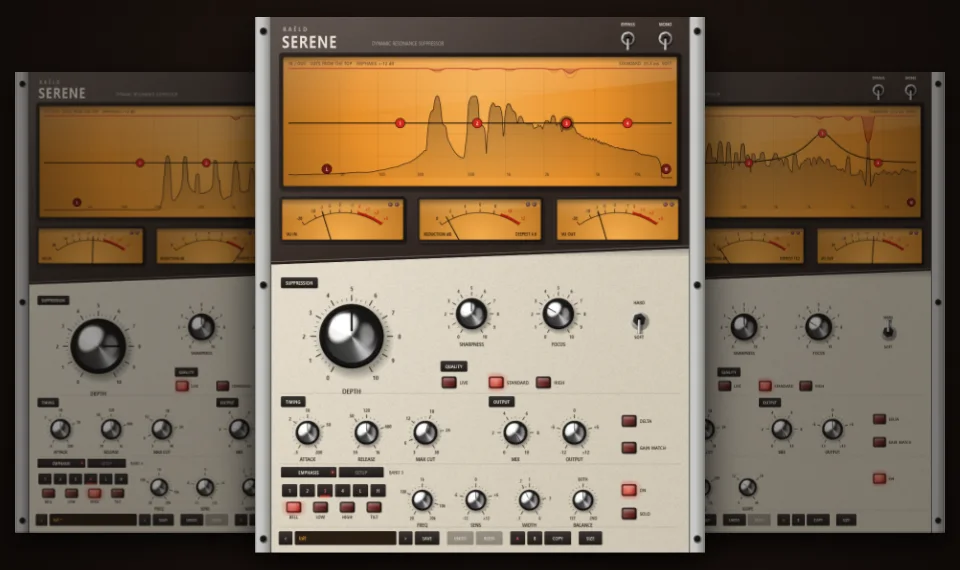
Then there is the harshness you never asked for: the ring in a snare, the whistle in a voice at 3 kHz. Raèld Serene finds those resonances as they happen and smooths only the ones that stand out, sparing the singer's own formants as they move. When nothing needs taming, the audio comes out exactly as it went in, bit for bit.

  • Character on request. EQ's WARM and PUNCH voicings add harmonics only from the bands you move. Flat stays perfectly flat.
  • Phase your way. Zero latency, a natural mode, or true linear phase for mastering.
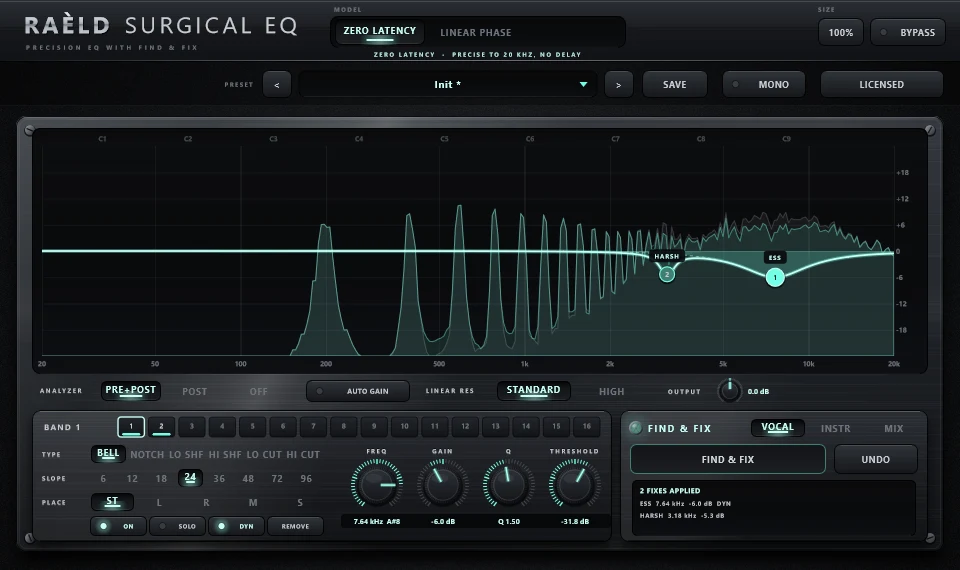
  • Surgery when you need it. Raèld Surgical EQ adds sixteen bands, dynamic bands and FIND & FIX.

By the numbers

0.15 dBRaèld EQ from the analog curve, all the way to 20 kHz
16 × 3reverb algorithms in Raèld Space, each in three eras of hardware
22echo machines in Raèld Echo, every one at zero latency
1 : 1bit-exact output wherever nothing needs to change
III

Depth

A room you can walk into

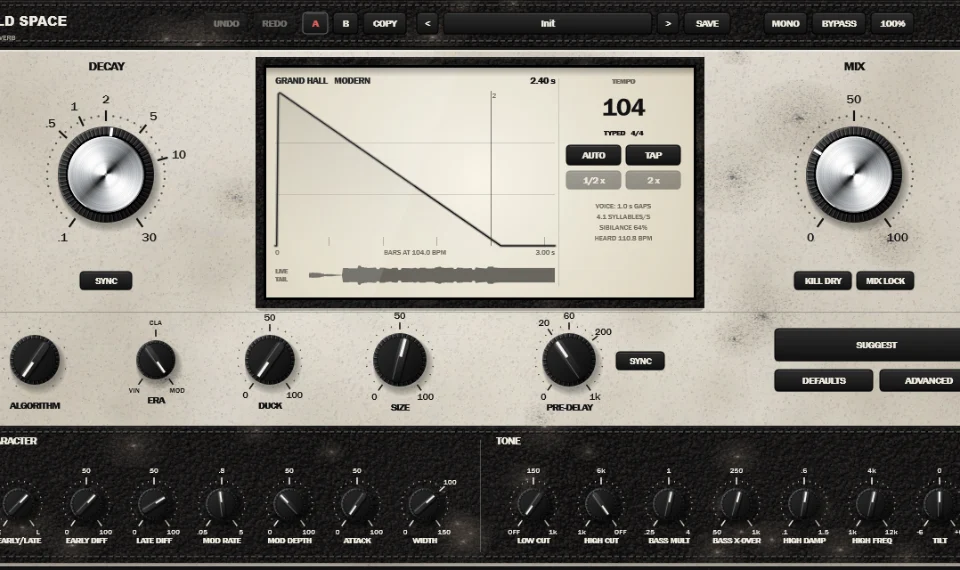
Depth is what turns a recording into a place. Raèld Space builds that place sixteen ways, from plates and chambers to halls, springs and shimmer, each in three eras of hardware running at its own internal rate. Every element of every loop carries its own decay, so the reverb time you set for each band is the reverb time you hear: lush, even tails with no metallic ring.

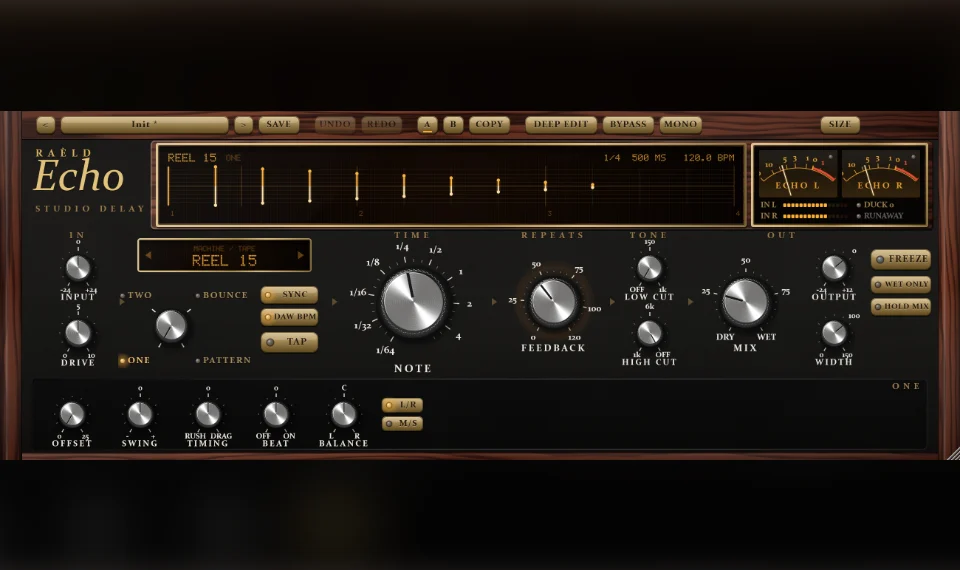
And when the room needs echoes, Raèld Echo brings twenty-two machines: studio tape, tape echoes, a magnetic drum, an oil can, bucket brigades and early digital. On the tape machines a time change bends the pitch through a motor with real inertia, the way a reel slows and catches up, and push FEEDBACK past 100 % to make the echoes bloom into self-oscillation, held safely under −1 dBFS.

  • In time with your song. Pre-delay, decay and echoes lock to the beat, and SUGGEST fits the space to your vocal.
  • Zero latency echoes. Play through Echo live; the dry signal stays untouched.
  • Words stay clear. DUCK lowers the tail while the singer sings and lets it bloom between phrases.
IV

Loudness

Loud, and still breathing

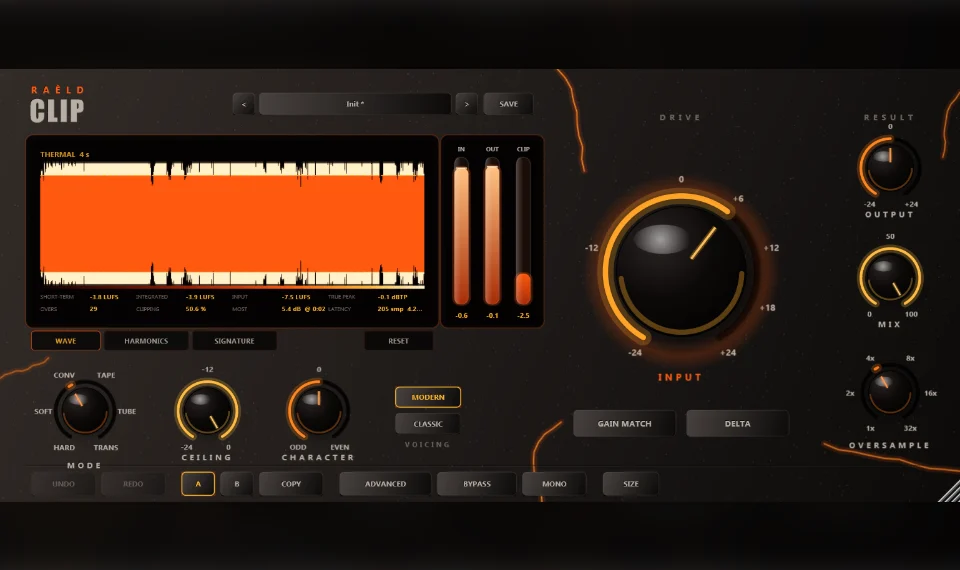
The last mile of a master is where most mixes lose their soul. Raèld's loudness tools are built to keep it. Raèld Clip shaves peaks with the curve you choose (an exact hard clip, a soft knee, a modern or classic converter, tape, tube or transistor), each one anti-aliased by its own maths, so even a hard clip lands clean. Below the clip point your audio passes through bit for bit.

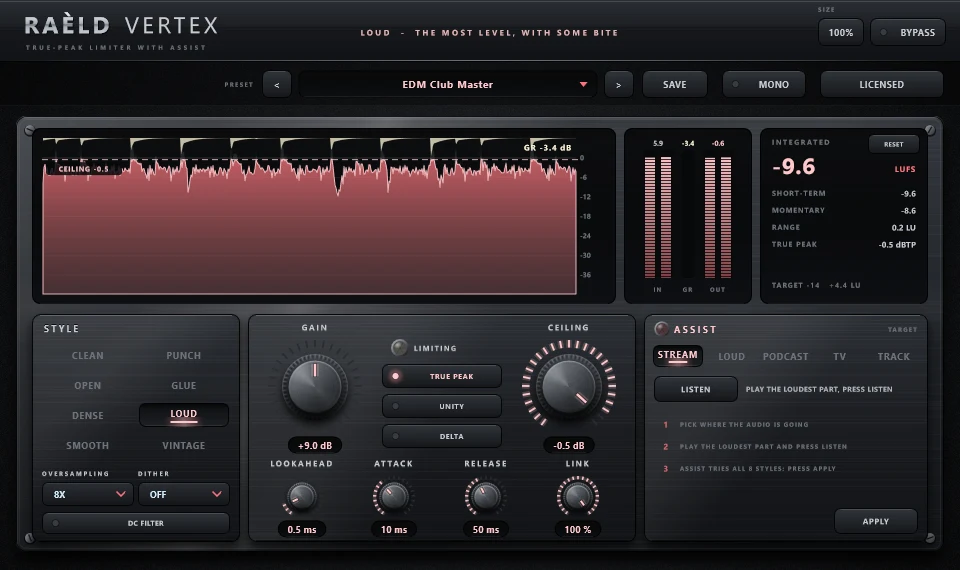
Raèld Vertex finishes the job with a true-peak limiter that reads between the samples with its own sixteen-phase detector and can listen to your song in all eight of its styles to pick the one with the least pumping and distortion.

  • Punch survives. Clip's PUNCH keeps the front of every transient sharp while the body gets louder.
  • Peaks stay put. TP SAFE and Vertex hold the true peak exactly where you set it.
  • Loudness you can trust. Vertex's meters follow the broadcast standard, checked against the EBU's own test files.

“We don't ask you to trust our ears. We print the numbers.”

Raèld Audio · On measurement

V

Finish

The details you only feel

Premium is not one big feature. It is a thousand small refusals. Raèld plugins refuse to click when you automate them, because every control glides. They refuse to comb-filter when you blend them, because the dry and wet signals are phase-aligned. They refuse to shift your timing, because every latency is reported to your DAW, and bypass crossfades against a matched dry signal.

They even refuse to stutter: nothing allocates memory while your audio plays, and the tests count to make sure. Each plugin ships only after its own suite has measured ratios, timings, frequency response, distortion, aliasing, latency and transparency. That is why a Raèld plugin feels finished the moment you open it.

The result is the sound you heard at the start of this story: a mix with weight and air, depth and punch, and nothing in the way. The sound of something expensive, at the price of a plugin.

Raèld

The range

Fourteen plugins, plugin by plugin

What each one does, the figures it ships with, and the maths that makes it sound the way it does.

Raèld Space
0-20-40-600 s1 s2 s3 sLow 2.6 sMid 2.0 sHigh 1.3 s

Decay per band, in dB over seconds (example settings).

Reverb

Raèld Space

Sixteen reverbs in three eras

A studio reverb with sixteen algorithms (halls, rooms, a chamber, plates, a spring, shimmer, gated, reverse and more), each in three eras of hardware: Vintage, Classic and Modern. Every algorithm has its own topology and its own numbers, so a plate sounds like a plate and a hall like a hall. SYNC locks pre-delay and decay to your song, SUGGEST fits the space to your tempo and vocal, and DUCK clears the tail while the singer sings.

Algorithms16 × 3 eras
Internal rates20 / 34 / 48 kHz by era
Late reverb8- or 16-line feedback network
Decayexact per band
DUCKup to 24 dB, zero latency
PresetsInit + 38 in 9 groups
The maths

Per-band loop gain

gband = 10−3·L / (fs·T60,band)

Every element of every loop carries its own decay, so the reverb time you set for each band is the one you hear.
Raèld Echo
0-10-20-300 s1 s2 s3 s

Repeats at FEEDBACK 70 %: each one 3.1 dB quieter (example).

Delay

Raèld Echo

Twenty-two echo machines

Twenty-two echo machines in one delay: studio tape, tape echoes, a magnetic drum, an oil can, bucket brigades, early digital and special effects. Play one, two, ping-pong or a rhythm of taps, sync it to the song, groove it, and push FEEDBACK past 100 % to make it bloom. The tape machines change time the way a real transport does, so the pitch bends and catches up.

Echo machines22 styles
Modessingle, dual, ping-pong, rhythm
Rhythm12 patterns, up to 16 taps
Latencyzero
Runaway feedbackheld under −1 dBFS
PresetsInit + 37, by use
The maths

Tape pitch on a time change

pitch = vnow / vthen

The head reads the tape that passed it at the old speed, so pitch moves with the motor, never backwards.

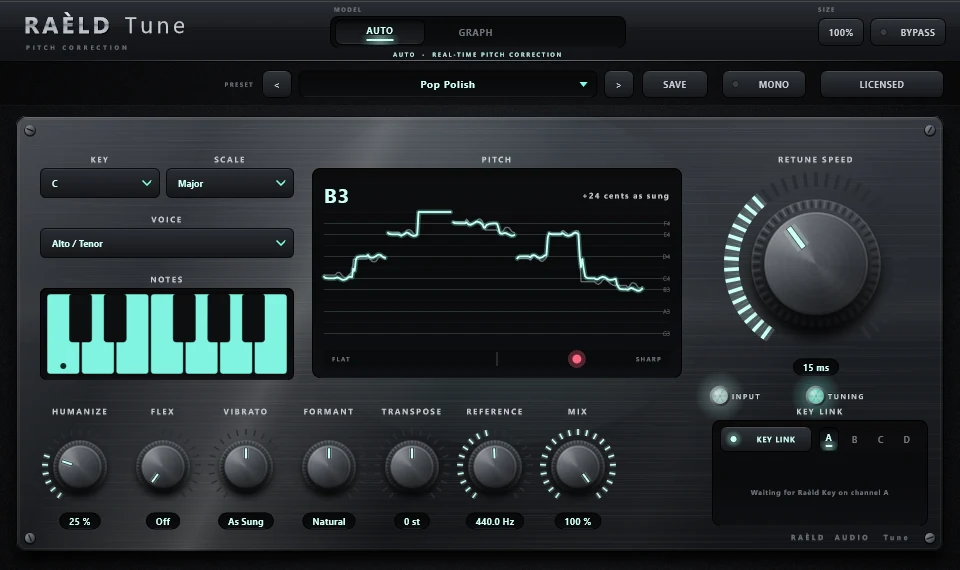
Raèld Tune
50250-25-500 s0.25 s0.5 s0.75 s1 sSungCorrected

A note sung 35 cents sharp, pulled to pitch (cents over time, example).

Pitch

Raèld Tune

Pitch correction, with Raèld Key

Real-time pitch correction for voices. It hears the sung pitch, finds the note, and moves the voice there by re-timing each pitch period, so breaths and consonants pass through untouched. RETUNE sets how quickly, VIBRATO keeps or removes the singer's own, and a MIDI input can steer it. Raèld Key, included, detects the song's key and sends it straight to Tune.

Methodpitch-synchronous re-timing
LatencyLIVE 10 ms · STUDIO 78.9 ms
Unvoiced soundspass bit for bit
Control rate1 kHz
Vibrato−100 % to +100 %
Raèld Keykey detection, 4 link channels
The maths

Distance from the note

cents = 1200 · log2(f / fnote)

A note 35 cents sharp is a frequency 2 % too high; Tune glides it home at the speed RETUNE sets.

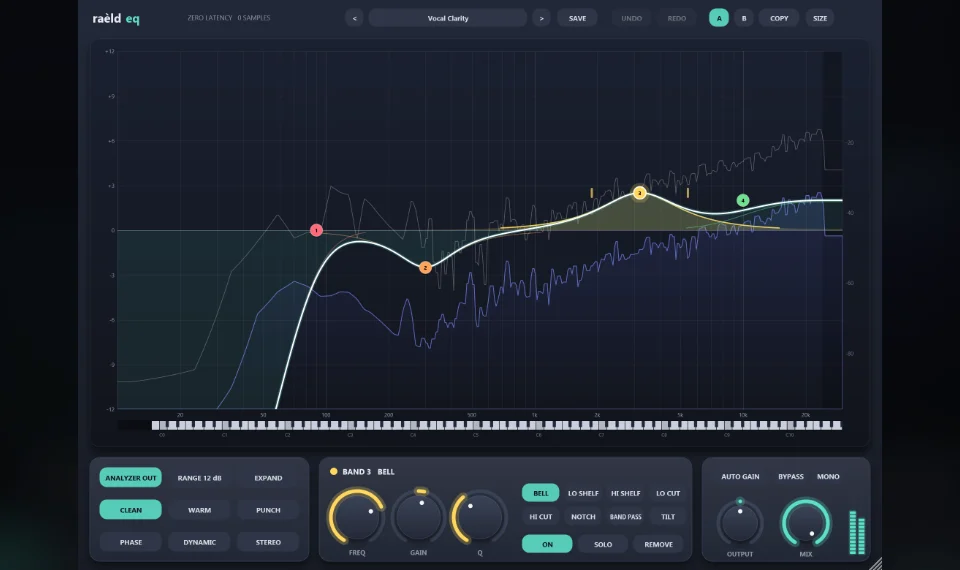
Raèld EQ
12 dB6 dB0 dB-6 dB-12 dB201001k10k20k−4 dB at 250 Hz, +5 dB air

A cut in the mud and a high shelf of air, the analog curves the bands match (example).

EQ

Raèld EQ

Parametric EQ built around its curve

A precise, simple parametric EQ built around its curve: drag a point and hear exactly what you see. Twenty-four bands of bells, shelves, cuts, notches, band-pass and tilt, each one dynamic if you want it, in stereo, left, right, mid or side. CHARACTER switches between CLEAN, WARM and PUNCH voicings, and the phase can be zero-latency, natural or linear.

Bands24, eight types
Cuts6 to 96 dB/oct
Accuracy≈ 0.15 dB from analog to 20 kHz
Updates1,500 per second, gliding
Phase modeszero, natural (55 samples), linear
Flatbit-exact, in every CHARACTER
The maths

The bell each band is matched to

H(s) = (s2 + (A/Q)·s + 1) / (s2 + s/(A·Q) + 1),  A = 10G/40

Each band is fitted to its analog curve right up to Nyquist, so the top end stays wide and soft.

Raèld Sculpt
0 dB-2 dB-4 dB-6 dB0 s0.25 s0.5 s0.75 s1 sAfter a passageAfter a hit

The gain coming back after a 20 ms hit and after a long passage, at the default.

Dynamics

Raèld Sculpt

Multiband dynamics, made silky

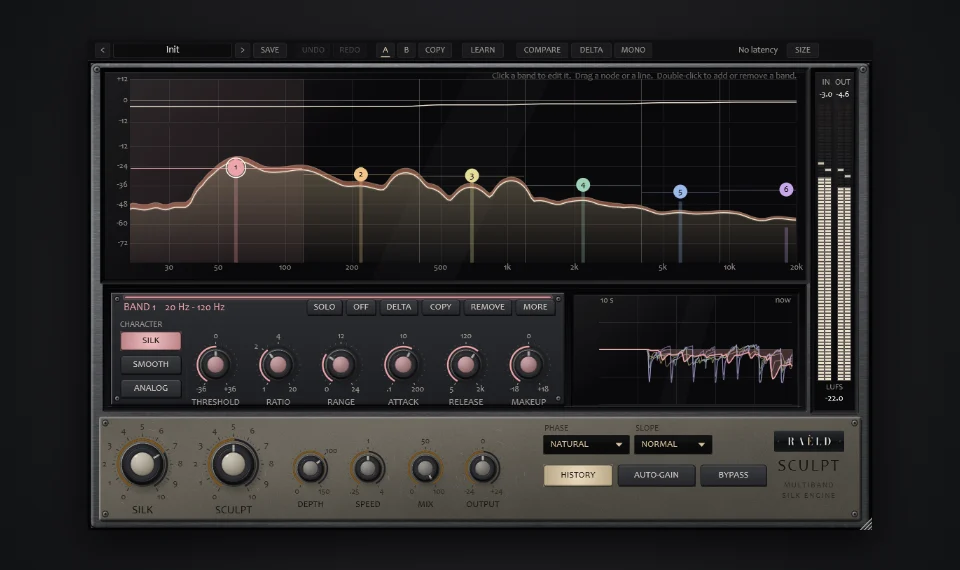
A multiband compressor made to be silky. Up to six bands that move together: the slow part of each band's gain is shared with its neighbours, so the tone stays put, while a hit stays the band's own. It learns where each band usually sits in your song and sets every threshold relative to that. SILK sets how it moves, SCULPT how far it reshapes, and each band has a CHARACTER: SILK, SMOOTH or ANALOG.

Bandsup to 6, down, up and expansion
PhaseNATURAL 0 ms · MINIMUM 0 ms · LINEAR 48 ms
At restNATURAL: bit for bit
Neighbours0.82 dB apart (1.0: 1.90)
CHARACTERSILK · SMOOTH · ANALOG, per band
PresetsInit + 13, at any level
The maths

The release follows the music

g(t) = g0 · e−t/τ,  τ = 93 ms after a hit, 399 ms after a passage

A short hit lets go quickly and a long passage slowly, with nothing to set.

Raèld Serene
0 dB-12 dB-24 dB-36 dB1001k10kInOut

A harsh vocal spectrum before and after: only the rings come down (example).

Dynamics

Raèld Serene

Dynamic resonance suppressor

A dynamic resonance suppressor. It finds the ringing, harsh and whistling frequencies as they happen and turns down only those, by only as much as they stand out, while sparing the natural shape of a voice or an instrument as it moves. SOFT or HARD character, an EMPHASIS curve you draw, mid/side lanes, a sidechain, and DELTA to hear exactly what it takes away.

Analysis3 resolutions, 1/48-octave grid
QualityLIVE 0 ms · STANDARD 21 ms · HIGH 43 ms
LIVEup to 12 gliding bells per lane
Nothing to cutoutput = input, bit for bit
StereoL/R or M/S lanes, LINK
PresetsInit + 19, by use
The maths

How much a resonance is cut

cut = DEPTH × max(0, excess − knee)

The excess is measured against the sound's own outline, so only what pokes out is touched.

Raèld Triad
-60 dB-40 dB-20 dB0 dB-60-40-200LOW LEVEL +12

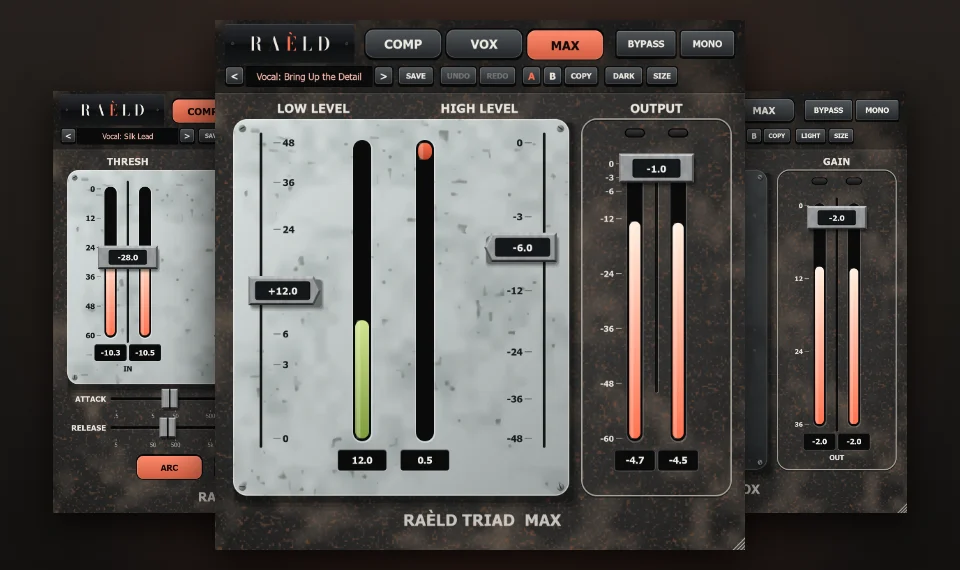
MAX, output against a steady input: quiet levels come up, the room and the loud parts stay.

Dynamics

Raèld Triad

Compressor, vocal leveler and maximizer

Three processors, one at a time. COMP, a full compressor, smooth on a voice: ELECTRO or OPTO, WARM or SMOOTH, and a release that can follow the music. VOX, on one fader, brings a voice forward: more reduction and more level together. MAX brings the quiet parts up level with the rest and leaves the room under the voice down.

ModesCOMP · VOX · MAX, one at a time
COMPELECTRO or OPTO, ARC, WARM or SMOOTH
VOXone fader, gentle GATE
MAXLOW LEVEL +12: phrases 8.79 → 1.70 dB apart
Ceilingon samples, in every mode
Latency64 samples, in every mode
The maths

Latency, the same in every mode

64 samples ÷ 48 kHz = 1.33 ms

Change mode and your timing never moves.

Raèld Vertex
0 dB-1 dB-6 dB-12 dB-12-606Ceiling −1 dBTP

Output against input: untouched below the ceiling, held at it above.

Limiter

Raèld Vertex

True-peak limiter with ASSIST

A true-peak limiter for masters and tracks. Eight styles shape how it catches peaks, from transparent to loud and vintage, with up to 16x oversampling and its own true-peak detector. ASSIST runs the real limiter on your song in every style and recommends the one with the least riding, pumping and distortion. Loudness meters follow the broadcast standard.

Styles8, clean to vintage
Oversamplingup to 16x
True peak16 points × 96 taps
Unlimited audiobit-exact at any rate
LoudnessBS.1770 / R128, checked vs EBU tests
ASSISTup to 30 s, every style
The maths

Integrated loudness

LUFS = −0.691 + 10·log10 Σ Gi·⟨zi2⟩

The meter you master to is the one the streaming services read.

Raèld Busscomp
0 dB-10 dB-20 dB-30 dB-40 dB-40-30-20-1002 : 14 : 110 : 1

Static curves at a −20 dB threshold (example knees).

Compressor

Raèld Busscomp

VCA bus compressor for drums, mix and master

A VCA bus compressor modelled on the classic console bus compressors: one stereo-linked gain (or mid and side), a detector that keeps bass half-cycles out of the gain, a knee that firms up with the ratio, and AUTO release on a network of two capacitors. ANALOG adds the harmonics of the VCA, the output stage and the transformer, with the bass saturating first.

Ratios2 : 1 · 4 : 1 · 10 : 1
Topologyfeed-forward VCA, peak hold 8–16 ms
Releasefixed, or AUTO (two capacitors)
ANALOG2x or 4x, 23 / 28 samples
ANALOG offzero latency, bit-exact below threshold
ExtrasSC FILTER, EXT KEY, M/S, AUTO GAIN
The maths

The knee

y = x + (1/R − 1)·(x − T + W/2)2 / 2W

Inside the knee the ratio eases in on a parabola, so the glue never grabs.

Raèld Gate
0 dB-20 dB-40 dB-60 dB-80 dB-80-60-40-200Expander 1 : 4, range 40 dB

The gate's curve: everything above the threshold untouched (example).

Noise reduction

Raèld Gate

Noise suppressor in five parts

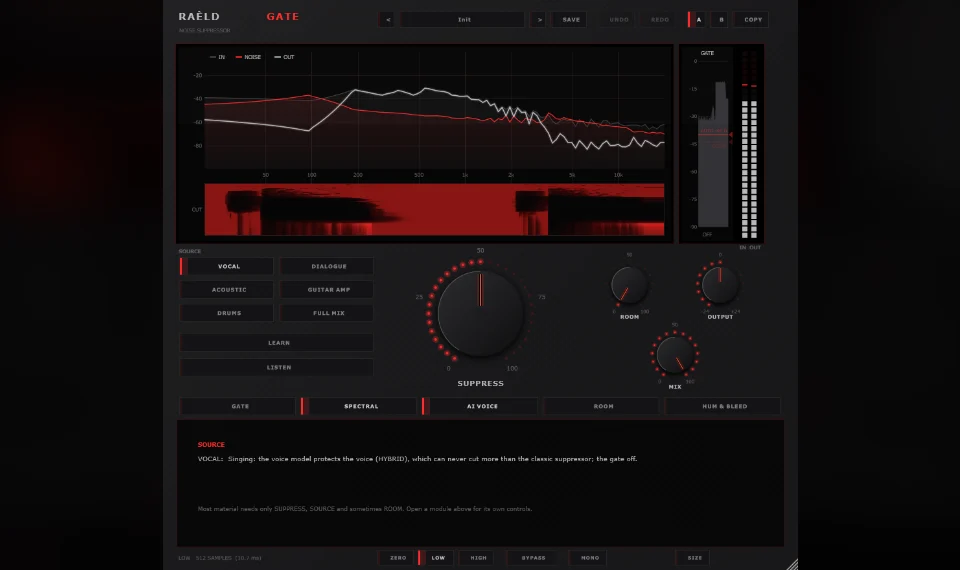
A full noise suppressor in five parts: a gate and expander, an adaptive spectral suppressor, an AI voice model, a room and de-reverb stage, and hum and bleed removal. Pick a SOURCE, press LEARN or let it follow the noise on its own, and it cleans dialogue, vocals and drums while the parts you want stay intact.

Modulesgate, spectral, AI voice, room, hum & bleed
LatencyZERO 0 · LOW 512 · HIGH 4096 samples
AI voice0.69 % of one CPU core
Hum50 / 60 Hz, harmonics and buzz
Nothing foundbit-exact
PresetsInit + 11, six SOURCEs
The maths

How much of each frequency stays

G = ξ / (1 + ξ)

A Wiener gain from each cell's signal-to-noise estimate: clean where the voice is, quiet where only noise is.

Raèld Surgical EQ
0 dB-10 dB-20 dB-30 dB-40 dB20601201801kHum notches at Q 10

Three narrow notches on 60 Hz hum and its harmonics (example).

EQ

Raèld Surgical EQ

Precision EQ with FIND & FIX

A precision EQ for the jobs that need a scalpel: sixteen bands of bells, notches, shelves and cuts on stereo, left, right, mid or side, any of them dynamic, with SOLO to hear a band alone. FIND & FIX listens for twenty seconds and offers a band for every resonance, build-up, ess and rumble it hears.

Bands16, any dynamic
Cuts6 to 96 dB/oct
Accuracywithin 0.25 dB of analog to 8 kHz
LINEAR PHASE8192 or 32768 taps
FIND & FIX20 s capture, ≈ 3 Hz bins
Channelsstereo, L, R, M or S
The maths

A notch

H(s) = (s2 + 1) / (s2 + s/Q + 1)

At Q 10 a notch is a tenth of an octave wide: the hum goes, the bass stays.

Raèld Clip
10.50-0.5-1-2-1012HARDSOFT

Transfer curves in units of the ceiling: identical below the knee.

Dynamics

Raèld Clip

Clipper, version 2.0

A clipper for masters, buses and single tracks. Shave the peaks and choose how it sounds: an exact hard clip, a soft knee, the overload of a modern or a classic converter, tape, tube or transistor. Everything below the clip point passes untouched, PUNCH keeps transients sharp, MULTIBAND splits it in up to three bands, and TP SAFE holds the true peak where you set it.

Modeshard, soft, 2 converters, tape, tube, transistor
Oversampling1x to 32x
Anti-aliasingADAA on every curve
Below the curvebit-exact
TP SAFE16 phases × 128 taps, 1 ms
PresetsInit + 11
The maths

Anti-derivative anti-aliasing

y[n] = (F(x[n]) − F(x[n−1])) / (x[n] − x[n−1])

The curve is integrated between samples, so the harmonics it makes stay below Nyquist.

Raèld i2a
0 dB-3 dB-6 dB-9 dB-12 dB0 s1 s2 s3 s4 s5 sfast, then slow

Gain reduction recovering after a loud phrase: a fast part, then a slow one (example).

Compressor

Raèld i2a

Optical leveling amplifier, version 2.0

An optical leveling amplifier modelled on the classic tube leveler: input transformer, attenuator, a 12AX7 and a 12BH7, output transformer. The sidechain lights an electroluminescent panel whose glow sets a photocell, which rises fast and falls in two stages, remembering long, heavy compression. Three models, from the earliest unit to the later grey and silver ones.

Models3: earliest, gray, silver
Gain stages12AX7 → 12BH7, two transformers
Releasetwo-stage, with memory
HF EMPHASISflat to the 75 µs curve
Oversampling4x
Model change40 ms crossfade
The maths

The HF emphasis corner

f = 1 / (2π · 75 µs) ≈ 2.12 kHz

Turn HF EMPHASIS up and the leveler reacts more to bright, sibilant sounds.

Raèld I76
0 dB-10 dB-20 dB-30 dB-40 dB-40-30-20-1004 : 120 : 1

Static curves at 4, 8, 12 and 20 : 1 (example threshold).

Compressor

Raèld I76

FET limiting amplifier, version 2.0

A FET limiting amplifier modelled on the classic blue-stripe, black-face and anniversary units, circuit stage by stage: input attenuator, input transformer with flux saturation, FET, preamp, class-A line amp and output transformer. The ratio buttons (and all of them at once) shift the knee the way the hardware does, and the release follows the program.

Models3: blue-stripe, black-face, anniversary
Ratios4, 8, 12, 20 : 1 and ALL
Releaseprogram-dependent, two stages
Oversampling2x or 4x, constant inner rate
Level0 VU = −18 dBFS
Model change40 ms crossfade
The maths

Above the threshold

y = T + (x − T) / R

Every 4 dB over the threshold at 4 : 1 becomes 1 dB; at 20 : 1 it is a brick.

Raèld Audio

Hear it on your own mix.

Own the plugins one by one, or every one of them with Raèld All Access, including each new plugin the day it comes out.

Raèld All AccessEvery Raèld plugin, one licence. VST3 and standalone for Windows.
Raèld Audio · the store