Raèld Echo 2.0. Twenty-two echo machines.
Studio tape and tape echoes, a magnetic drum and an oil can, bucket-brigade pedals, studio digital from the late 70s to the 90s, and a few special ones. Each machine records, plays back and loses tone the way its kind does, so every repeat sounds like that machine. Lock it to your song, bounce it, pattern it, and push the feedback past 100 % into a held self-oscillation you can play.
One-time payment · 3 computers · Free update for 1.0 owners
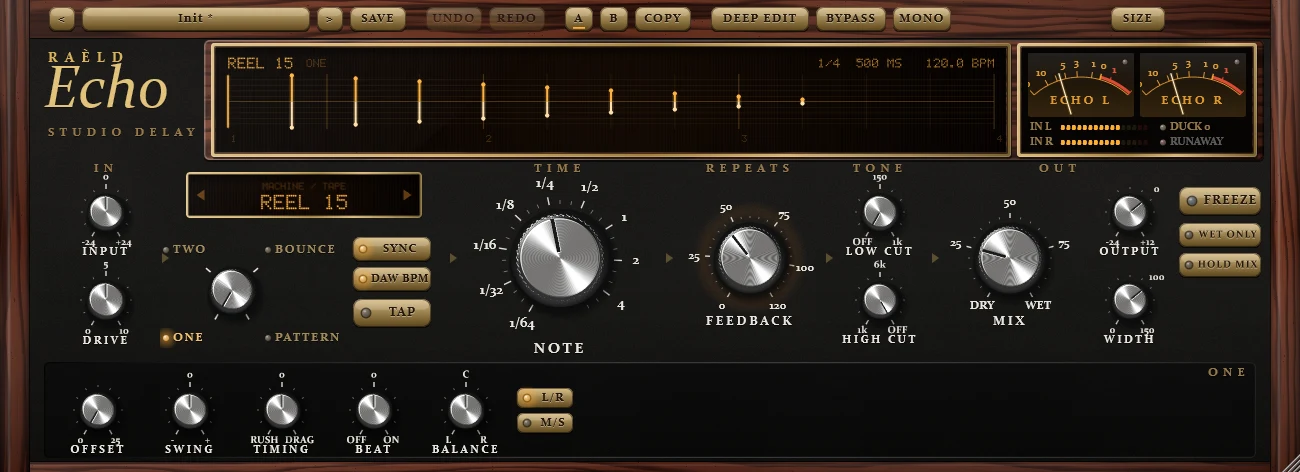
Pick a machine, set the time, play it
1. Pick a MACHINE
Step through the 22 or choose one by family. Each one's echo is matched to your input's level, so switching changes the colour, not the volume.
2. Set the TIME
A note value at your song's tempo, from 1/64 to 4 bars, straight, dotted or triplet, or milliseconds. TAP it in if you like.
3. FEEDBACK and MIX
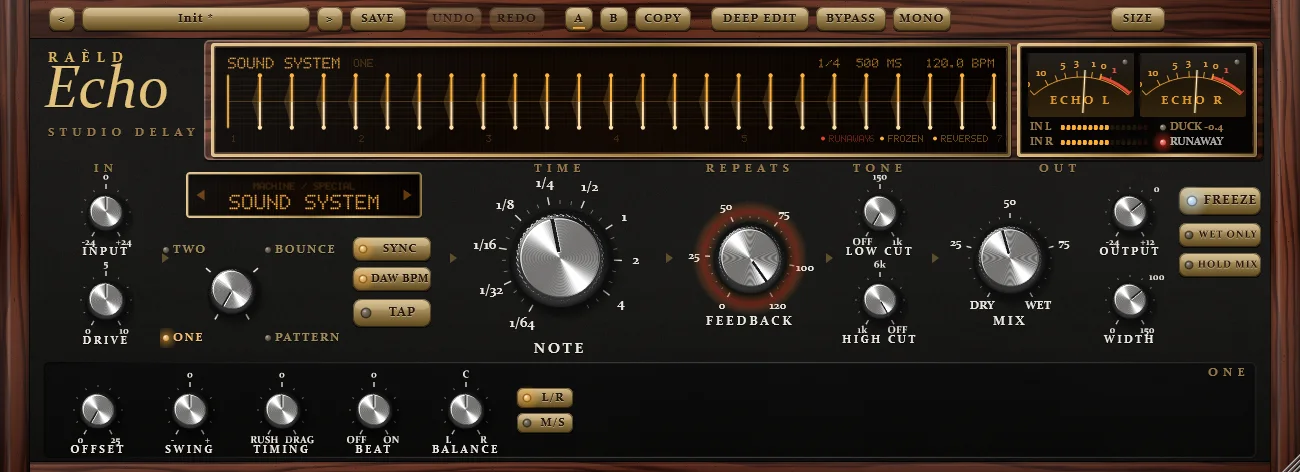
How many repeats and how loud. DRIVE gives more of the machine's grit; LOW and HIGH CUT shape every repeat. The display draws the echoes on your song's grid.
Five families of echo
Each machine is modelled on the behaviour of its kind of equipment: how it records, how its tape or chips or converters lose the top and add grit, how its speed wobbles, how it hisses. Pick a family to see one of its machines at work.
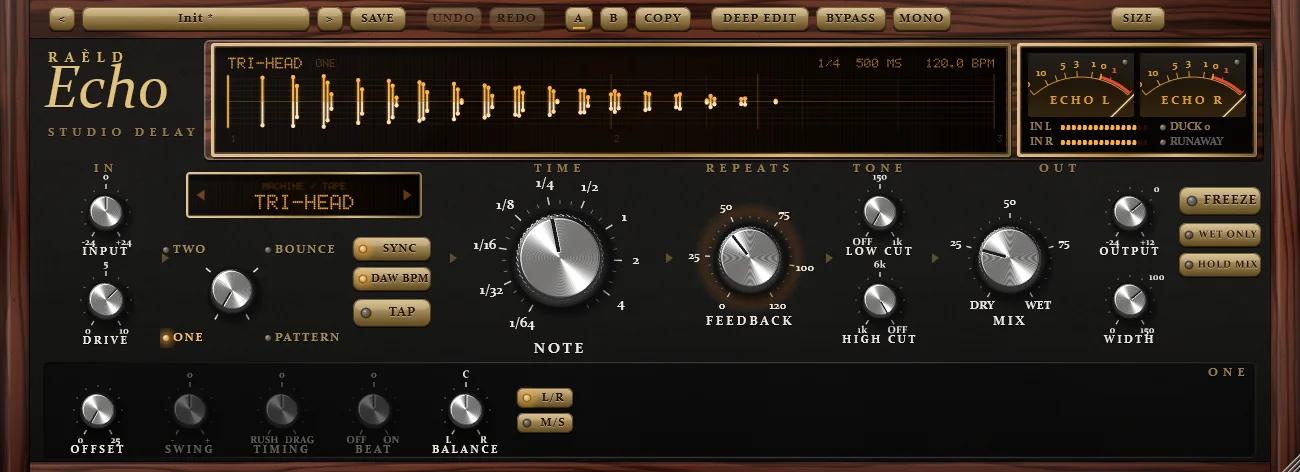
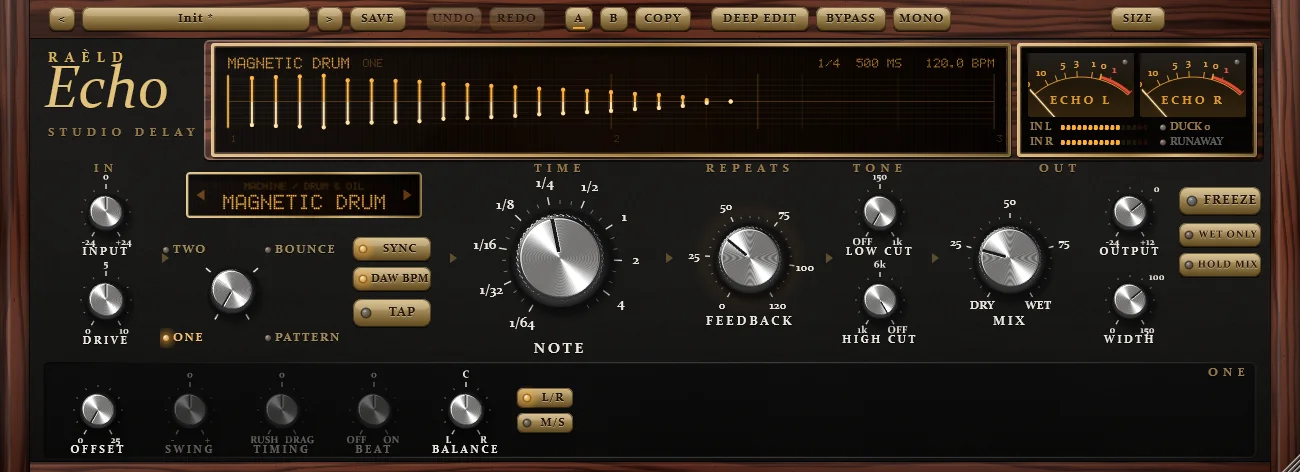
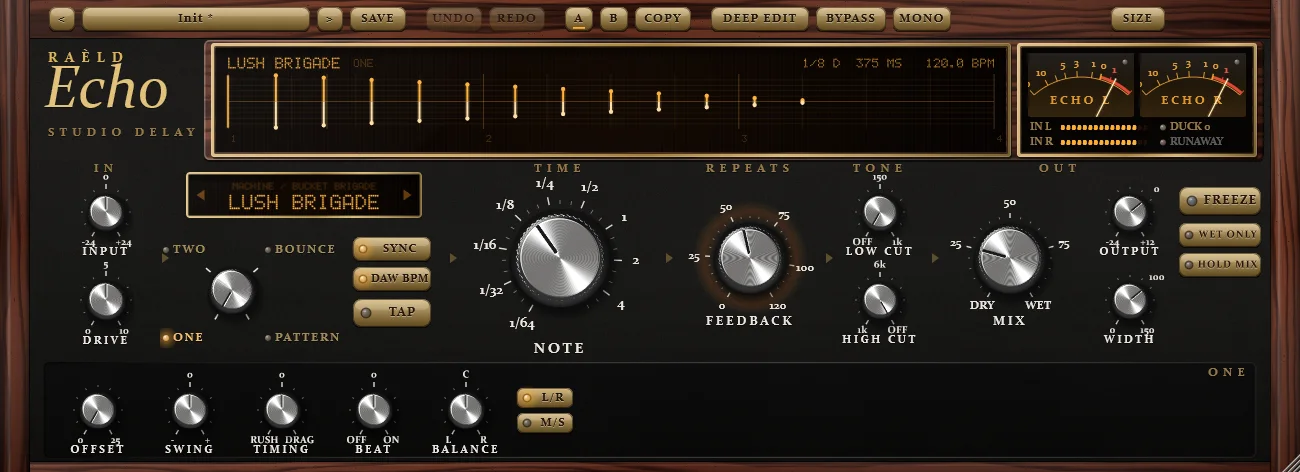
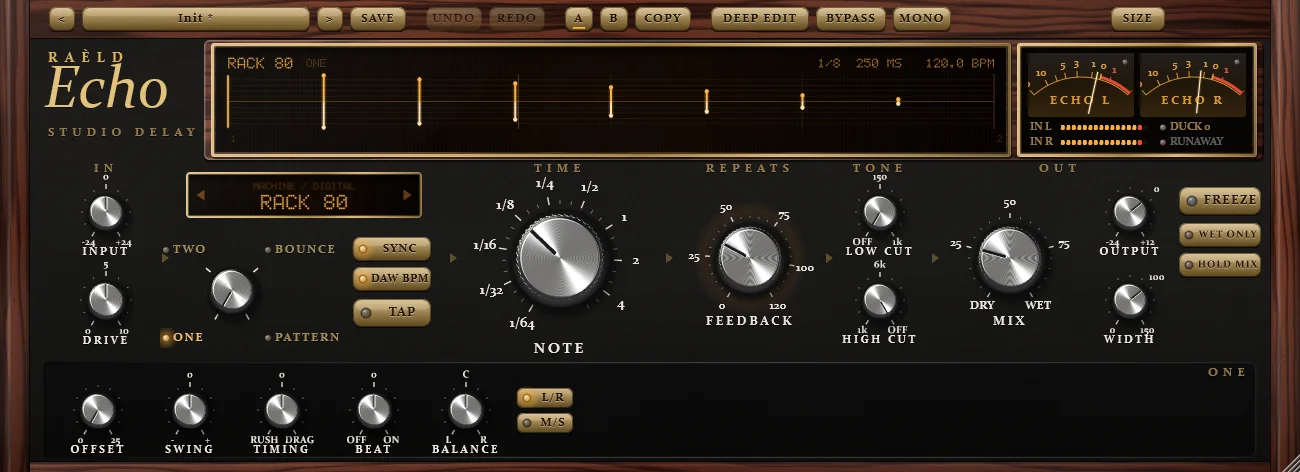
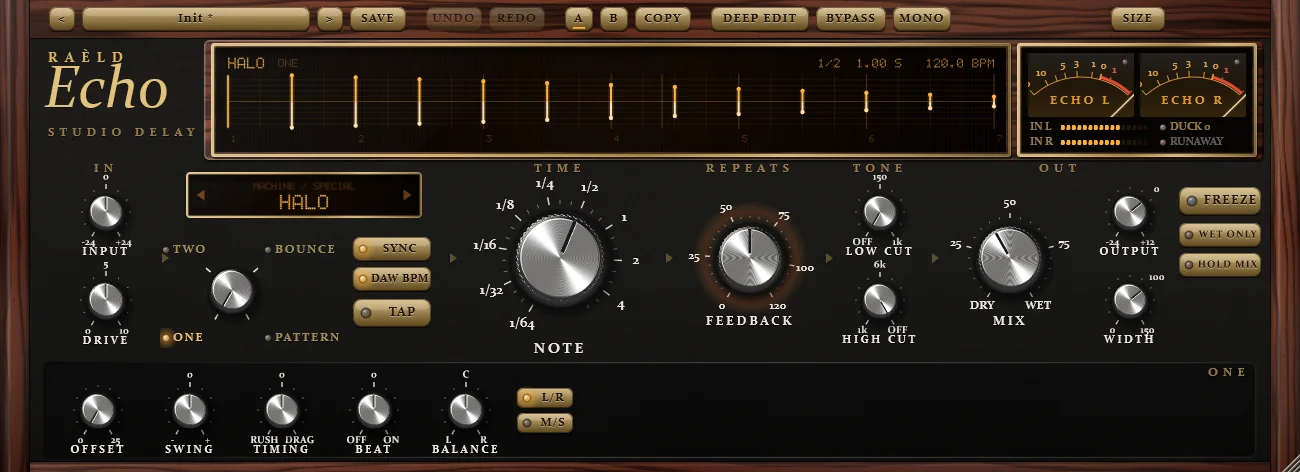
TAPE · REEL 30, REEL 15, SLIDE HEAD, TRI-HEAD, CASSETTE, WORN LOOP
| Machine | Sound |
|---|---|
| REEL 30 · REEL 15 | A high-end studio deck at 30 ips (wide, smooth) and 15 ips (the classic slap and throw) |
| SLIDE HEAD · TRI-HEAD | Tape echoes: one head with forward mids and grit; three heads in a galloping pattern |
| CASSETTE · WORN LOOP | Compressed, hissy, fluttering; an old stretched loop with dropouts and wobble |
| MAGNETIC DRUM · OIL CAN | Four heads on a spinning drum, steady and round; electrostatic recording in oil, dark and smeared |
| BRIGADE · LUSH BRIGADE · STUDIO BRIGADE | A classic analog pedal; the same with its chorus; a 70s/80s rack with more bandwidth |
| 12-BIT RACK · RACK 80 · RACK 90 | Studio digital: late-70s grain, 80s warmth and clarity, 90s nearly clean |
| CLEAR · SAMPLER 8 | Pristine (each echo the input, bit for bit); an 8-bit sampler's aliasing, by choice |
| PHONE LINE · RADIO DIAL | A telephone line; AM radio with static and drift |
| SOUND SYSTEM | A tape echo voiced for dub: a resonant loop built to run away and be played |
| HAZE · MIRROR · HALO | Repeats that smear into a wash; reverse echoes; repeats an octave up |
One echo, two, a bounce or a pattern
Turn the MODE switch and the strip along the bottom shows only that mode's controls.
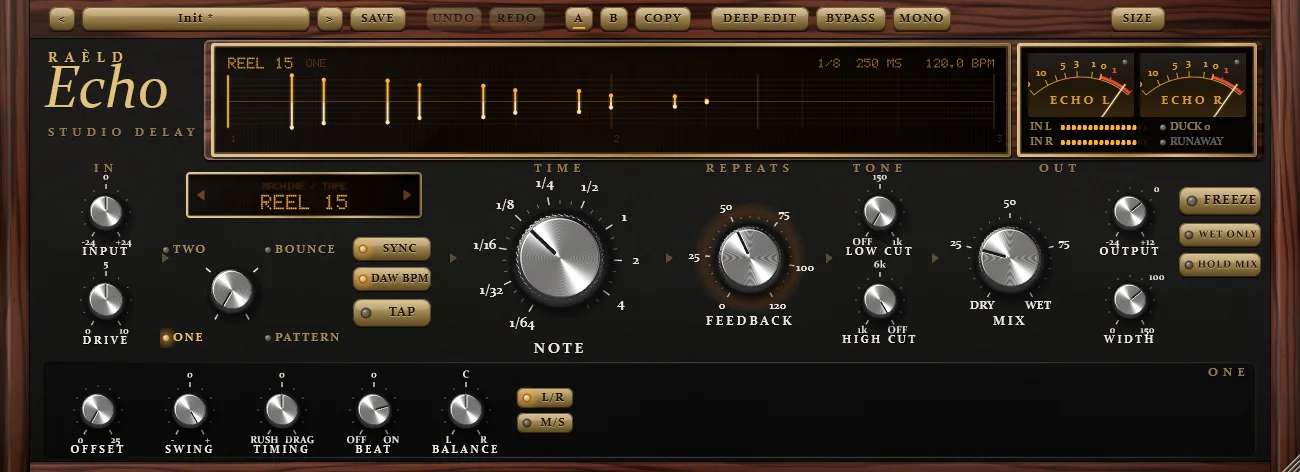
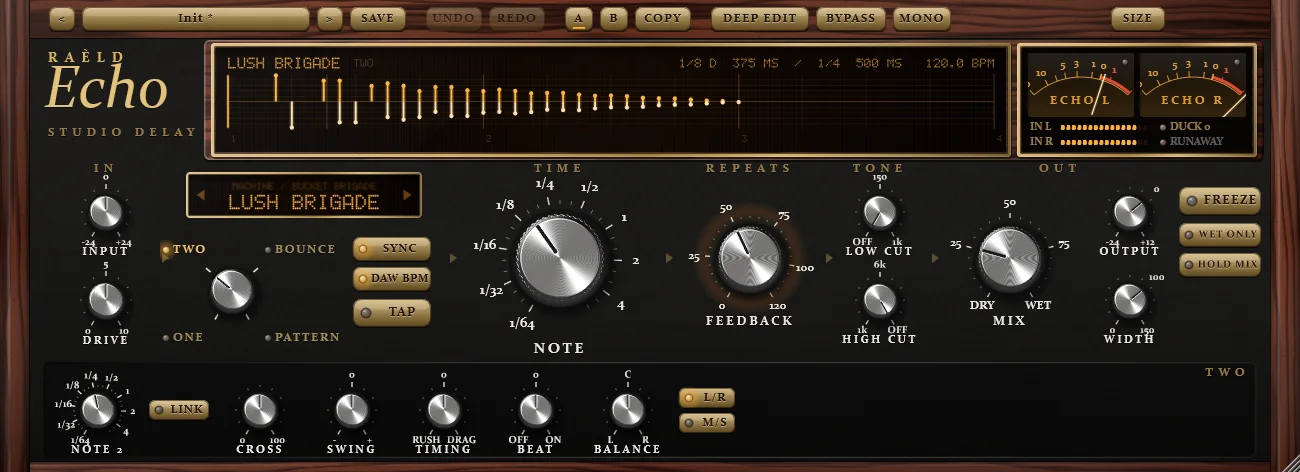
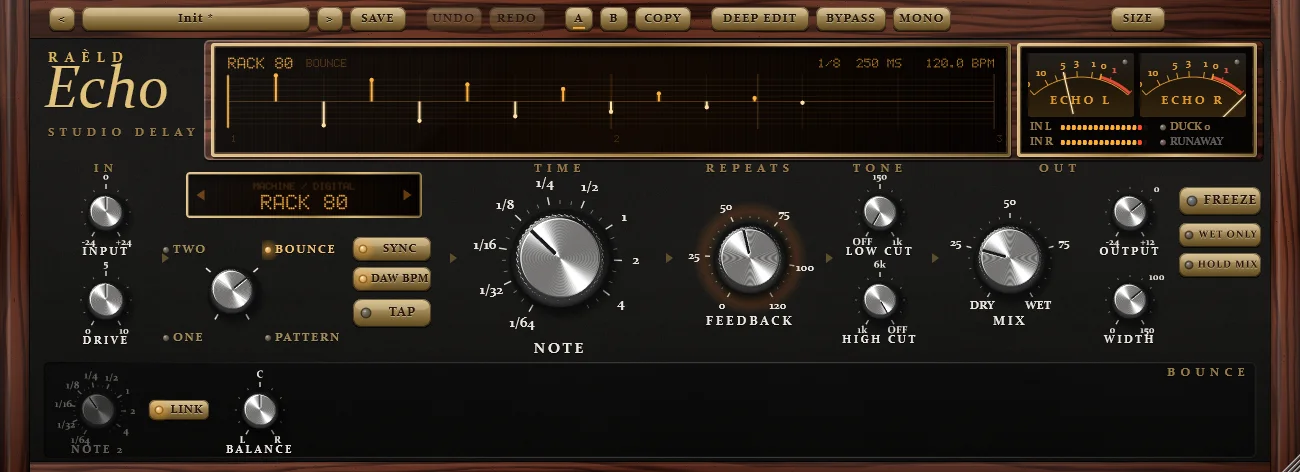
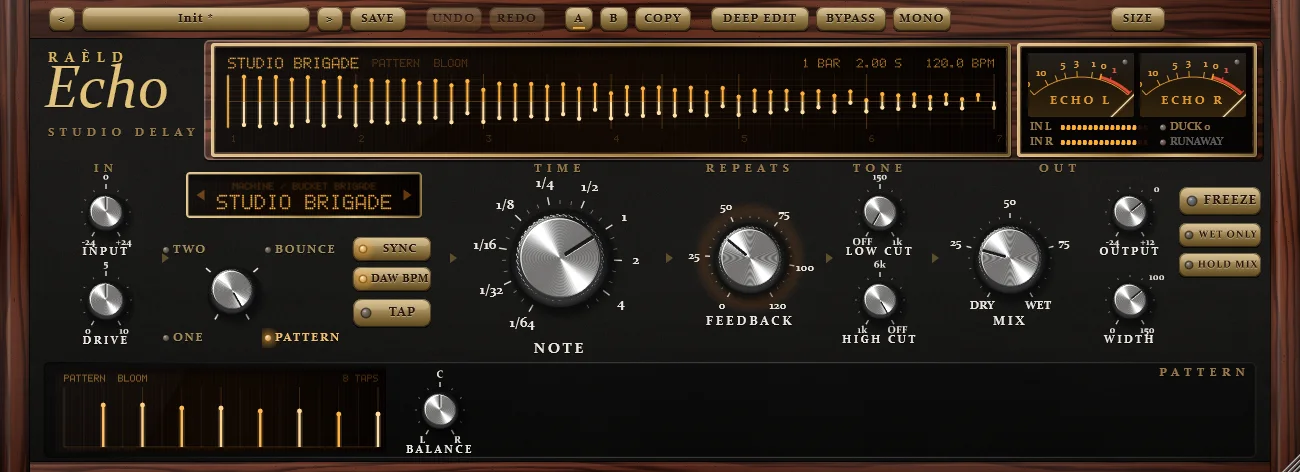
ONE · one machine; OFFSET widens it, SWING, TIMING and BEAT give it a groove
Echoes in time with your song
With SYNC on, TIME is a note value from 1/64 to 4 bars, straight, dotted (D) or triplet (T). DAW BPM follows your song's tempo and time signature, or tap it in with TAP.
- A quarter note is 60,000 ÷ BPM ms; a dotted note ×1.5; a triplet ×2/3.
- Tempo changes follow at once. A synced time change crossfades cleanly; in milliseconds, a tape machine bends the pitch like a real transport.
- SWING, TIMING and BEAT push the echoes into a shuffle, ahead of or behind the beat, and accent the on- or off-beats.
Measured: every note value from 1/64 to 4 bars, at 40 to 240 BPM, lands within half a sample.
Try it at your tempo
| Feel | Note | Time |
|---|---|---|
| Straight | 1/4 | 500 ms |
| Dotted | 1/8D | 375 ms |
| Triplet | 1/4T | 333 ms |
The dotted row is the next shorter note dotted: from a 1/4, the 1/8D, the famous dotted-eighth guitar echo. The full chart is in the manual.
Simple on the front, everything underneath
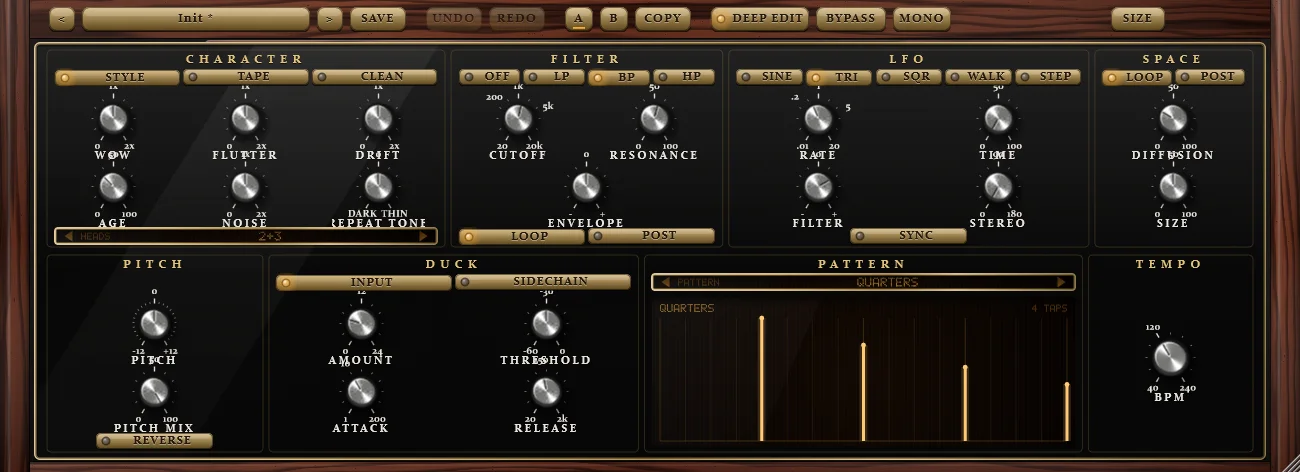
The faceplate has what most material needs. DEEP EDIT opens the rest over it, in the same black and rosewood.
The machine's character
WOW, FLUTTER, DRIFT and NOISE from none to twice the machine's own; AGE for wear; REPEAT TONE, each repeat darker or thinner; which HEADS play on the multi-head machines.
Filter and LFO
A resonant low-, band- or high-pass in the loop or after it, moved by an envelope or an LFO with five shapes. In the loop, it plays a self-oscillating echo.
Space, pitch, reverse
DIFFUSION smears repeats into a cloud. PITCH shifts each repeat by semitones, again on every pass. REVERSE plays them backwards.
FREEZE
Hold what's in the loop, repeating for ever, while you play over it.
DUCK
The echoes step back while you play, by up to 24 dB, keyed by the input or by another track on the sidechain.
Rhythm patterns
Choose PATTERN mode's rhythm from twelve and see its taps: where they fall, how loud, and where they sit left to right.
Let it run away, safely
At 100 % the loop holds its level. Past it, the echoes build into a self-oscillation that settles around 0 VU and never clips: the RUNAWAY lamp lights, and you play it with TIME, the filter and FREEZE. SOUND SYSTEM is voiced for it.
What we measured
On test signals and synthetic vocals, guitars, drums and synths, at 48 kHz.
| What | Result |
|---|---|
| Latency | none; the dry signal untouched, bit for bit |
| Echoes on time | CLEAR to the sample; the other machines within 0.05 ms (OIL CAN and PHONE LINE 0.09 ms); every synced note value within half a sample |
| The machines' level | each echo matched to the input in the mids within 0.03 dB; DRIVE keeps it within 0.01 LU from 0 to 100 % |
| Self-oscillation | settles at −17.5 to −21.8 dBFS RMS on 18 machines, steady to 0.01 dB over ten minutes, peaks under −2 dBFS |
| DUCK | 6, 12 and 24 dB set: −6.0, −12.0 and −24.0 dB measured, through the sidechain too |
| Switching | no clicks changing TIME, MACHINE, MODE, FREEZE, REVERSE, PITCH, the filter or the pattern |
| Mono | every machine at its defaults folds to mono with no loss |
| CPU, stereo 48 kHz | 1 to 2 % of one core for a typical machine, up to about 3 % with every feature on |
Thirty-seven presets, by what you're working on
Turn HOLD MIX on when the echo is on a send, so the presets leave your level alone.
| For | Presets |
|---|---|
| Vocals | Rockabilly Slap, Tight Double, Quarter Throw, Dotted Tape Throw, Ambient Wash, Radio Callback, Phone Throw |
| Guitar | Dotted Lead, Tape Gallop, Surf Drum, Chorus Echo, Oil Can Swirl |
| Drums | Snare Slap, Ping-Pong Eighths, Gap Filler, Trash Room |
| Synth | Dual Cross, Wide Taps, Filter Sweep, Arp Rhythm |
| Dub | Sound System, Siren Runaway, Offbeat Skank |
| Ambient and cinematic | Halo Shimmer, Frozen Pad, Reverse Swell, Octave Abyss, Long Tape Bloom |
| Rhythm | Clave, Tresillo, Swung Sixteenths, Shuffle Eighths |
| FX | Tape Bend, Telephone Ghost, Envelope Wah, Random Warble, Fifth Climb |
Plus Init and your own, with A / B compare, undo and redo.
Before and after
Press play, then flip between Before and After. Both play in sync, so you hear the same moment either way.
2.0 is a free update
Raèld Echo 2.0 replaces 1.0: same plugin, same licence. Your 1.0 sessions open with the nearest 2.0 settings, and your 1.0 user presets are rewritten once for 2.0, with the originals kept. The engine is new, so a 1.0 session sounds close to before, not identical.
| 1.0 type | 2.0 |
|---|---|
| Digital, Tape, Multi-Head, Analog | CLEAR, SLIDE HEAD, TRI-HEAD, BRIGADE |
| Ping-Pong, Dual | CLEAR in BOUNCE, CLEAR in TWO |
| Slapback, Dub, Lo-Fi | REEL 15, SOUND SYSTEM, SAMPLER 8 |
| Diffused, Reverse, Shimmer | HAZE, MIRROR, HALO |
Own it, or get it with everything else
Raèld Echo
One-time payment. No subscription.
- Raèld Echo, VST3 and standalone
- One license for up to 3 of your computers
- Never expires, works offline 30 days at a time
- Download link and license key by email, instantly
Every Raèld plugin
or $99/year
- Raèld Echo plus every other Raèld plugin
- Every new plugin the day it's released
- One key for all of them, on 3 computers
- Cancel anytime
Secure checkout by Lemon Squeezy. Sales tax and VAT calculated at checkout.
Windows 10/11 (64-bit), VST3 and standalone. Works in Ableton Live, FL Studio, Cubase, Studio One, Reaper, Bitwig and other VST3 hosts.
Good to know
Insert or aux send?
Both. On an insert, MIX sets the echoes against the dry signal, which is never touched. On a send, switch on WET ONLY so only the echoes come out, and HOLD MIX so the presets you try leave your level alone.
Where do I get the dotted-eighth guitar echo?
Turn SYNC on and set TIME to 1/8 D (375 ms at 120 BPM), or load the Dotted Lead preset. For the classic two-time version, try TWO with a 1/8 D and a 1/4.
What happens past 100 % feedback?
The echoes build into a self-oscillation. A governor holds it around 0 VU and the echoes never pass −1 dBFS, so it can't blow up your speakers. Sweep TIME on a tape machine or the filter in the loop to play it; FREEZE holds it.
Does it add latency or use much CPU?
No latency at all. About 1 to 2 % of one CPU core for a typical machine, up to about 3 % with every feature on.
How close are the machines to the real thing?
Each one is modelled on the documented behaviour of its kind of equipment: how it records and plays back, its tone loss per repeat, wobble, noise and saturation, measured in our tests. They're original designs, not copies of any product, and we don't claim they match any particular unit.
Should I buy it or subscribe?
If Raèld Echo is the only Raèld plugin you want, buying it is cheapest over time. If you want the others too, or every new one as it comes out, All Access costs less up front. Compare both.
Can I try it first?
Yes. Without a key the plugin runs as a full demo; the only limit is a short dropout every 45 seconds. Enter a key any time to unlock it, with no reinstall.
Does it work on Mac, and on mono tracks?
Not on Mac yet: Raèld Echo is VST3 and standalone for 64-bit Windows 10 and 11. It runs on mono, mono-to-stereo and stereo tracks, and the MONO switch folds the output to mono to check a mix.
Read the Raèld Echo manual · All support questions →
Raèld Echo's machines are original designs modelled on the general behaviour of tape, drum, oil-can, bucket-brigade and digital echo equipment. Raèld Echo is not affiliated with any other manufacturer.