Raèld Surgical EQ. Find the bad frequency. Cut only that.
A 16-band precision EQ for taking out the frequencies that make a sound bad, above all in vocals. Every band is true to its analog curve up to 20 kHz, can be as narrow as Q 40 or a deep notch, can sit on both channels, one side, the middle or the sides, and can be dynamic, so it cuts only when the problem shows. FIND & FIX listens to your track and, with one click, puts a precisely sized cut on every bad frequency it finds.
One-time payment · 3 computers · Instant download
One click, a cut on every problem
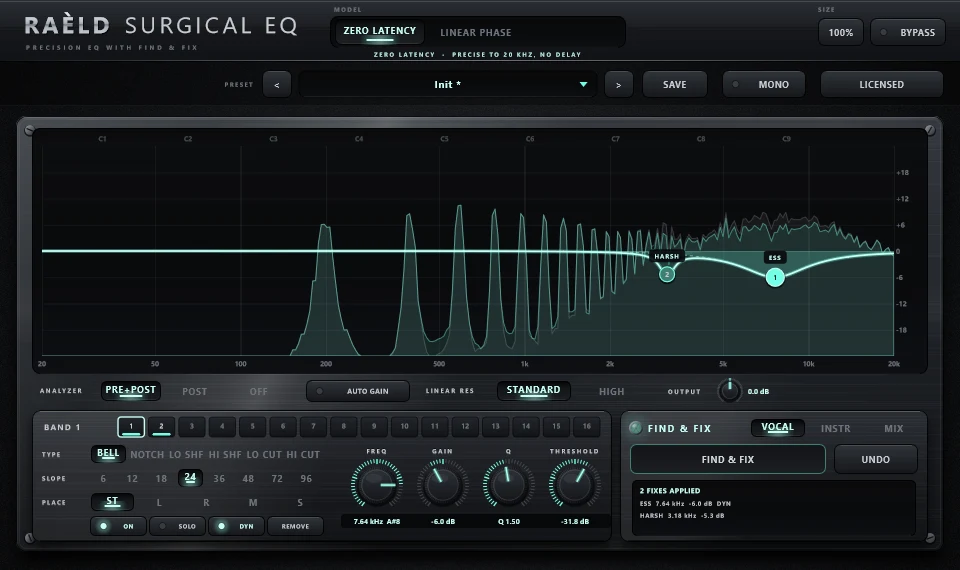
Choose VOCAL, INSTR or MIX, play the worst-sounding part, and click. It listens for 6 seconds, then puts a precisely sized cut on every bad frequency it finds, naming each one on the curve: HARSH, NASAL, ESS, MUD and more. UNDO takes it all back out.
| It finds | The fix |
|---|---|
| Resonances | Pinpointed to their exact frequency and width, and cut by their measured excess. There all the time: a static cut. Only on some notes: a dynamic cut that acts only when it appears. |
| Build-ups | Broad boom, mud, boxiness and harshness: a broad bell. |
| Sibilance | A dynamic cut at the esses' centre, only when they happen. |
| Rumble under a voice | A low cut. |
FIND & FIX measures; it's a precise starting point to listen to, measured on test signals. Always listen to its cuts, and use SOLO to check.
On vocals it hunts narrow resonances above 600 Hz, because held notes' own low harmonics look like peaks. Low problems are found as broad mud, boom and boxiness instead.
Zero latency or linear phase
ZERO LATENCY (teal): every band true to its analog curve up to 20 kHz, with no delay, for tracking and mixing. LINEAR PHASE (blue): no phase shift at all, for masters, stems and parallel work; it adds 96 ms of latency, or 352 ms at HIGH resolution. The body stays the same dark, polished metal; the lights take the mode's colour. Pick a screen below.
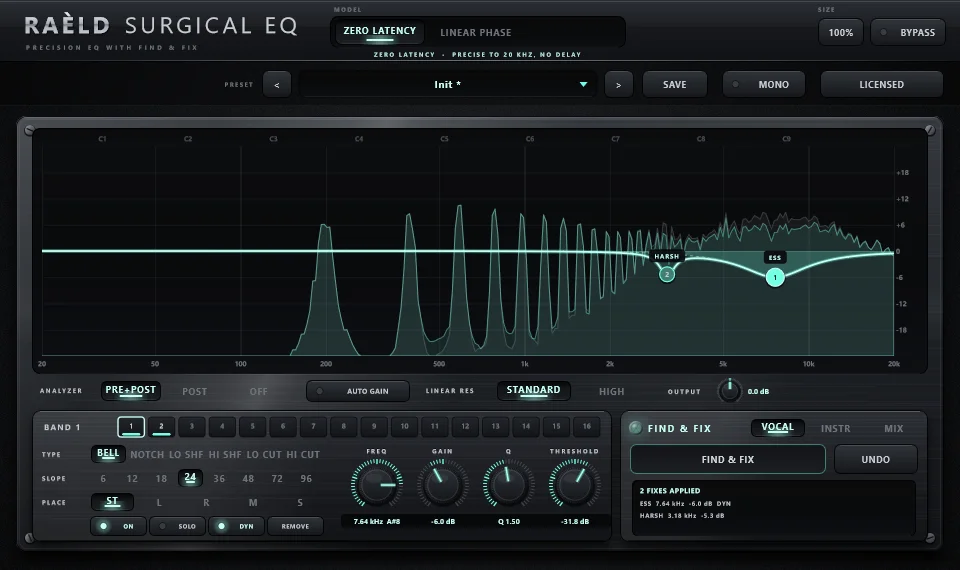
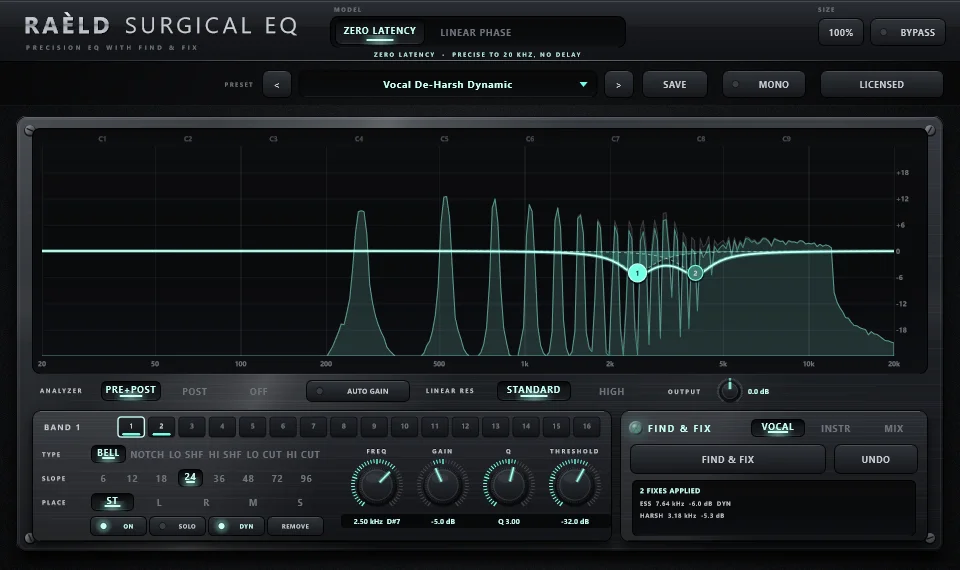
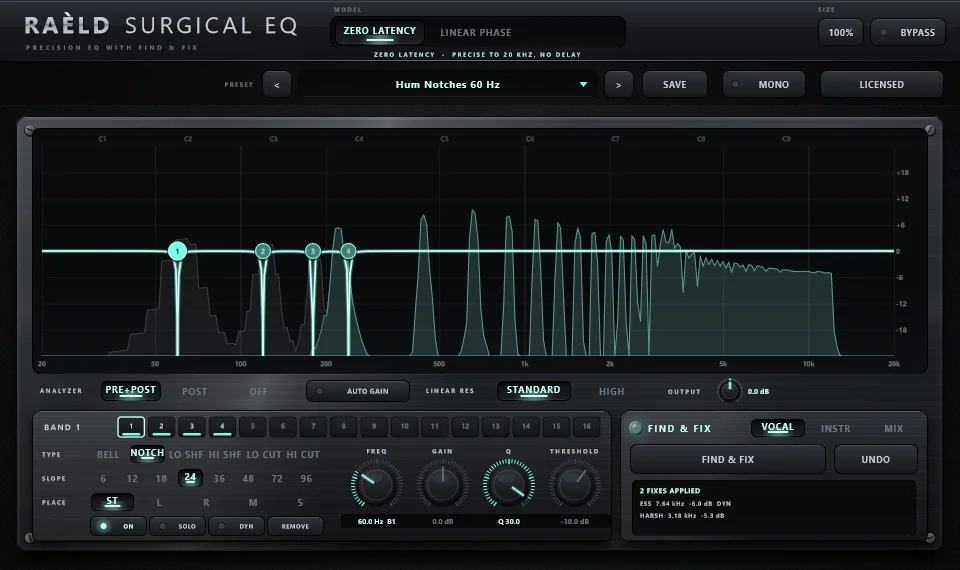
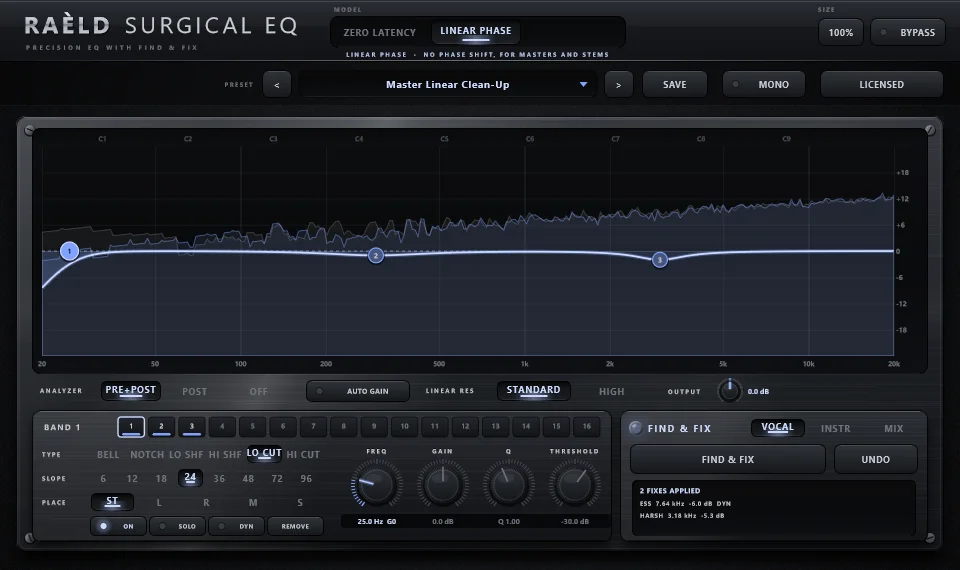
FIND & FIX · HARSH and ESS cuts placed and named after one click
Precise where it matters
Bells, notches, shelves and cuts
Bells up to Q 40, a deep notch, low and high shelves, and low and high cuts from 6 to 96 dB/oct. Measured: a Q 40 bell lands exactly on its −15 dB and is 1 dB a semitone away; a Q 10 notch is 66 dB deep.
Stereo, L, R, mid or side
Each band works on both channels, the left or right only, the middle or the sides: a low cut on the sides for a tight mono bass, a plosive cut on the middle only. Measured: a LEFT band leaves the right untouched; a MID band leaves the sides untouched.
Dynamic bands
Bells and shelves can be dynamic (DYN with a THRESHOLD), so they act only when their frequency rises. Measured: a dynamic −9 dB band cuts 0 dB below threshold and exactly 9 dB above it.
A curve you work on
Double-click to add a numbered node, drag to move, scroll to narrow, right-click for options; ALT-drag to hear only that band while you sweep. Frequency and musical note are shown everywhere, so you can cut on the pitch of a ring.
16 band chips, vernier dials
Every band has its chip for quick selection, and precision vernier dials for FREQ, GAIN, Q and THRESHOLD. SOLO hears one band's region; AUTO GAIN keeps the level steady so you judge the tone, not the loudness.
Clean in both modes
Linear phase is within 0.003 dB of zero latency, with a symmetric impulse response (the same delay at every frequency). No clicks when a band is swept. A live pre/post analyzer shows what changed.
What we measured
| Test | Result |
|---|---|
| Bells and shelves against their analog curves, measured to 19 kHz | within 0.25 dB for bands from 60 Hz to 8 kHz (0.41 dB for broad bands at 16 kHz) |
| A Q 40 bell at −15 dB | exactly −15 dB at its centre; 1 dB a semitone away |
| A Q 10 notch | 66 dB deep |
| Cut slopes | 24 dB/oct measures 24.0; 96 dB/oct measures 96.2 |
| Linear phase against zero latency | within 0.003 dB; symmetric impulse response |
| Placement | a LEFT band leaves the right untouched; a MID band leaves the sides untouched |
| A dynamic −9 dB band | 0 dB below threshold, exactly 9 dB above it |
| A band swept across a tone | no clicks |
| FIND & FIX, test vocals with planted problems | a 3200 Hz resonance pinpointed at 3180 Hz, two-thirds of its excess removed; a resonance present only half the time set as a dynamic cut; the esses caught with a dynamic cut; nothing found on a clean voice; about 0.1 s of thinking |
| CPU, all 16 bands | 1.3% of one core (zero latency); 0.6% (linear) |
Linear phase adds latency (96 ms, or 352 ms at HIGH), and makes very narrow cuts below about 200 Hz shallower. Use ZERO LATENCY for hum notches.
20 presets to start from
Each places the bands for one job, ready to fine-tune by ear.
| For | Presets |
|---|---|
| Vocals | Vocal Clean Start, Vocal De-Mud, Vocal Nasal Fix, Vocal De-Harsh Dynamic, Vocal De-Ess Surgical, Vocal Air & Polish, Rap Vocal Presence, Podcast Voice, Backing Vocals Thin-Out, Plosive & Rumble Cut |
| Instruments | Kick Box Cut, Snare Ring Notch, Guitar Fizz Tamer, Piano Clean Lows |
| Fixes and mixes | Hum Notches 60 Hz, Hum Notches 50 Hz, Mix Mud Cleanup, Mono Bass (Side Low Cut), Master Linear Clean-Up |
Plus Init.
Own it, or get it with everything else
Raèld Surgical EQ
One-time payment. No subscription.
- 16 bands and FIND & FIX, plugin and standalone
- One license for up to 3 of your computers
- Never expires, works offline 30 days at a time
- Download link and license key by email, instantly
Every Raèld plugin
or $99/year
- Raèld Surgical EQ plus every other Raèld plugin
- Every new plugin the day it's released
- One key for all of them, on 3 computers
- Cancel anytime
Secure checkout by Lemon Squeezy. Sales tax and VAT calculated at checkout.
Windows 10/11 (64-bit), VST3 and standalone. Download Raeld-Surgical-EQ-1.0.0-Windows.zip; DAWs list it as "Raeld Surgical EQ", so type "raeld" to find it.
Good to know
How is this different from Raèld EQ?
Raèld EQ is for shaping tone with the character of four classic EQ models. Surgical EQ is for taking problems out: narrow, deep, placed cuts on exactly the bad frequency, dynamic where needed, and FIND & FIX to find them for you.
Will FIND & FIX fix every recording?
No. It measures what it hears and gives you a precise starting point: a cut on each problem it finds, named on the curve. Always listen to its cuts, adjust any band, or press UNDO. On vocals it hunts narrow resonances above 600 Hz; low problems are found as broad mud, boom and boxiness.
Zero latency or linear phase?
ZERO LATENCY for tracking and mixing, and for hum notches. LINEAR PHASE for masters, stems and parallel work, where nothing should move in time; it adds 96 ms of latency (352 ms at HIGH) and makes very narrow cuts below about 200 Hz shallower.
How do I find a bad frequency by ear?
Hold ALT and drag a node to hear only that band as you sweep; when the ring jumps out, let go and cut. The readout shows the frequency and its musical note.
Does it work on mono tracks?
Yes. It runs on mono, mono-to-stereo and stereo tracks, and your DAW picks automatically. On a mono-to-stereo track the mono source feeds both sides. The MONO switch folds the output to mono, to check how the mix holds up on a mono speaker. It's click-free, works while bypassed, and isn't saved in presets. The bottom bar shows how it's running: MONO, STEREO or MONO > STEREO.
Can I try it first?
Yes. Without a key it runs as a full demo; the only limit is a short dropout every 45 seconds. Enter a Raèld Surgical EQ key or your All Access key any time to unlock it.
Read the Raèld Surgical EQ manual · Download · All support questions →
Raèld Surgical EQ is an original design and is not affiliated with or endorsed by any other manufacturer.