
Raèld i2a 2.0. Smooth, musical leveling.
Raèld's own plugin, modelled on vintage tube optical leveling amplifiers in three versions of the hardware: the earliest gray-green unit, the classic gray and the silver reissue. It's built from the circuit: the input transformer, the light panel and photocell that do the leveling, two tube stages and the output transformer. All of its timing comes from the optical cell, so it catches quickly, lets go in two stages and remembers how hard it has worked.
One-time payment · 3 computers · Instant download
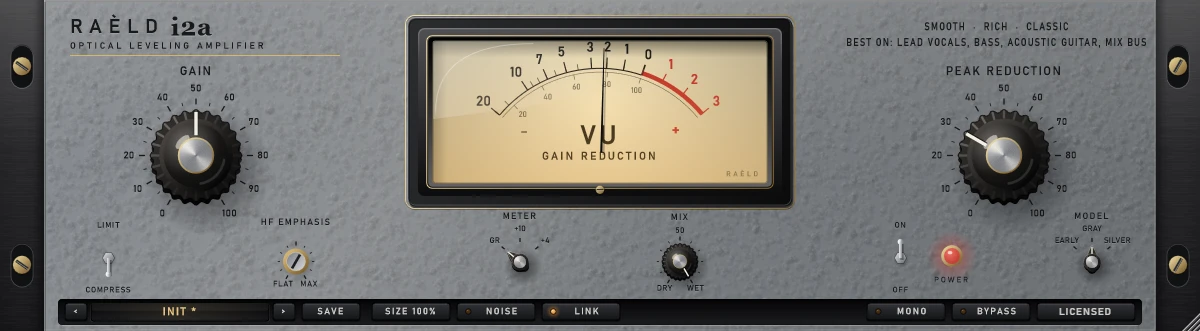
Leveling that follows the music
Built from the published circuits and specifications, and measured against them in our test suite: the threshold, ratios, timing, distortion, frequency response and noise below are what we measured.
A real optical cell
The sidechain lights an electroluminescent panel, and its glow sets the photocell. The louder the music, the brighter the glow and the more it levels, so it reacts to the program, not to fixed timings.
Two-stage release, with memory
It lets go fast at first, then slowly. After a short, light burst it's all back in under a second; after long or heavy compression it takes up to 11 seconds. That's the smooth, breathing leveling these units are loved for.
COMPRESS or LIMIT
The toggle switch: COMPRESS is the gentle curve, about 2.3 to 3.2:1; LIMIT is firmer, about 4.7 to 5.9:1, both with a soft knee.
HF EMPHASIS
The screwdriver trim. At FLAT the whole spectrum pushes the cell equally; turned up, the highs push it harder, up to a broadcast pre-emphasis curve, so bright, sibilant sounds are leveled more.
MIX, in time
Blend the leveled and the untouched signal for parallel compression. The dry path is time-aligned, so it never comb-filters.
POWER
Switch the unit off and the signal passes untouched, crossfaded and in time, while the lamp fades like a filament. POWER isn't saved in presets.
Tube colour
Two tube stages and the transformers add mostly 2nd-harmonic warmth: about 0.24% at +10 dBm and 0.69% at +16 dBm with no reduction. Colour, not grunge.
NOISE and LINK
NOISE adds each model's own analog noise floor (off by default). LINK runs one optical cell for both channels to keep the stereo image; off, each side levels on its own.
Calibrated VU
The needle shows gain reduction, or the output with 0 VU at +10 or +4, with 0 VU at −18 dBFS. The window scales from 90 to 200% and reopens at the size you left.
Pick the leveler that suits the song
MODEL changes the whole unit: its cell, its tubes, its noise and its faceplate. The change is a short crossfade, never a click. The inscription on each faceplate says what it does and what it's best on; hover over it for a starting setting. Pick one below to see it.
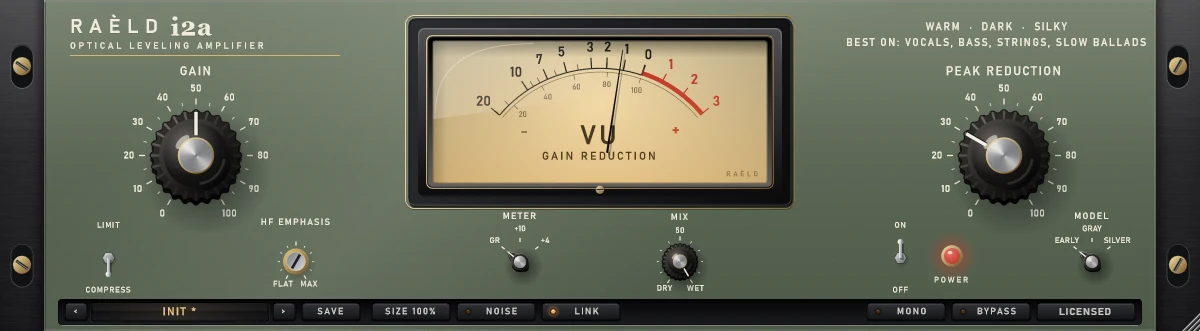
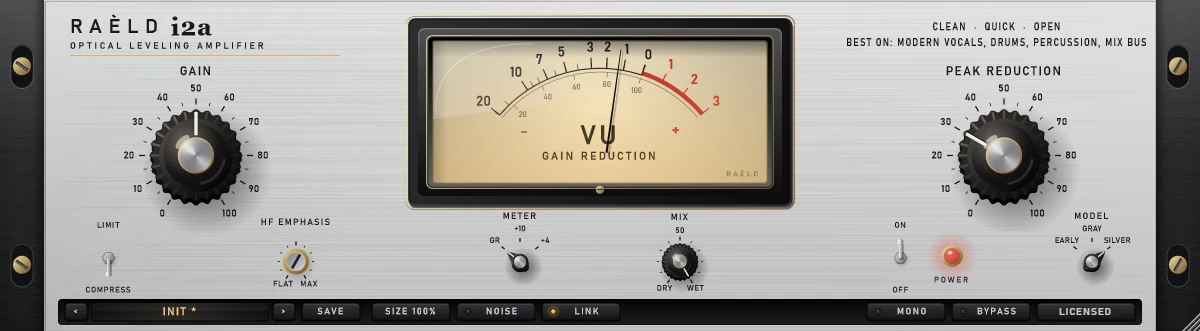
GRAY · the classic: smooth, rich, classic
Two knobs do it all
Turn PEAK REDUCTION until the needle shows the amount you want (3–6 dB on a vocal), then set the level with GAIN. GAIN never changes the compression; 50 is unity, and each step is 0.8 dB.
| Control | What it does |
|---|---|
| GAIN | The output level, 0–100. 50 is unity. |
| PEAK REDUCTION | How hard the optical cell is lit, so how much it compresses. |
| LIMIT / COMPRESS | The toggle switch: COMPRESS is gentle (about 2.3–3.2:1); LIMIT is firmer (about 4.7–5.9:1). |
| HF EMPHASIS | The screwdriver trim: from FLAT up to a broadcast pre-emphasis curve, so the highs push the cell harder. |
| METER | Gain reduction, or the output with 0 VU at +10 or +4. |
| MIX | The leveled and the untouched signal blended, in time. |
| POWER | Off: the unit is out and the signal passes untouched, crossfaded and in time. Not saved in presets. |
| MODEL | EARLY, GRAY or SILVER. |
| NOISE · LINK | In the strip along the bottom: the model's analog noise floor, and one optical cell for both channels. |
| MONO · BYPASS | Hear the output folded to mono (not saved in presets); the untouched input, in time and crossfaded. |
Knobs: drag up and down (Shift for fine control), use the mouse wheel or the arrow keys; double-click resets. A readout shows the value while you adjust, and the selectors click into each position.
Specifications
Measured on the gray model at 48 kHz, PEAK REDUCTION 50, GAIN 50, unless stated. 0 VU = −18 dBFS.
| Test | Result |
|---|---|
| Threshold, 1 dB of reduction | COMPRESS −12.6 VU, LIMIT −10.8 VU |
| Ratio | COMPRESS 2.3:1 rising to 3.2:1; LIMIT 4.7:1 rising to 5.9:1 (a soft knee) |
| Attack, to 63% | 10.6 ms to 4 dB of reduction; faster when hit harder (2.3 ms to 20 dB) |
| Release | Its first half in 62–148 ms. All of it takes 0.8 s after a short, light burst and up to 11 s after 20 s of heavy reduction. |
| Distortion, no reduction | 0.235% at +10 dBm, 0.685% at +16 dBm; mostly 2nd harmonic |
| Frequency response | −0.21 dB at 20 Hz, within 0.1 dB from 30 Hz to 20 kHz, at 44.1–192 kHz |
| Noise, NOISE on | 75 dB below +10 dBm |
| Latency | 93 samples at 44.1/48 kHz, 85 at 88.2/96 kHz, 0 at 176.4/192 kHz. Reported to your DAW automatically. |
| CPU | About 1.4–2.5% of one core, stereo, any model, any rate |
6 presets, plus Init
Init is the gray at COMPRESS, PEAK REDUCTION 30, GAIN 50 (unity). If a preset levels too much or too little for your track, adjust PEAK REDUCTION, then set the level with GAIN.
2.0 is a free update
Raèld i2a 2.0 replaces Raèld i2A 1.0 and is a free update: it's the same product with the same plugin ID, and the license key you have activates it. Install it over 1.0 and your sessions open with their settings translated; your own 1.0 presets are translated the first time 2.0 opens, each original kept beside it as .raeldpreset.v1. The sound is new, so a session may need a touch of PEAK REDUCTION to get the same amount of leveling.
| In 1.0 | Opens in 2.0 as |
|---|---|
| Gray | GRAY |
| Silver | SILVER |
| Vintage | EARLY |
| PEAK REDUCTION, GAIN, COMPRESS/LIMIT, EMPHASIS, MIX, LINK | The same values |
| Meter OFF | GR |
Own it, or get it with everything else
Raèld i2a
One-time payment. No subscription.
- Raèld i2a with all three models
- One license for up to 3 of your computers
- Never expires, works offline 30 days at a time
- Download link and license key by email, instantly
Every Raèld plugin
or $99/year
- Raèld i2a plus every other Raèld plugin
- Every new plugin the day it's released
- One key for all of them, on 3 computers
- Cancel anytime
Secure checkout by Lemon Squeezy. Sales tax and VAT calculated at checkout.
Windows 10/11 (64-bit), VST3 and a standalone app. Download Raeld-i2a-2.0.0-Windows.zip; DAWs list it as "Raeld i2a", so type "raeld" to find it.
Good to know
Where are the attack and release knobs?
There aren't any, as on the hardware: all of the timing comes from the optical cell. It catches quickly (faster the harder it's hit), lets go fast at first and then slowly, and lets go more slowly still after long or heavy compression. You choose how much with PEAK REDUCTION, and how firmly with COMPRESS or LIMIT.
Which model should I use?
The gray is smooth and rich, a great default for lead vocals, bass and the mix bus. The earliest is warm, dark and silky, the slowest and softest, lovely on ballads and strings. The silver is clean, quick and open, for modern vocals, drums and percussion. The inscription on each faceplate says the same, and hovering over it gives a starting setting.
What does HF EMPHASIS do?
It changes what the optical cell hears. At FLAT every frequency pushes it equally; turned up, the highs push it harder, so bright and sibilant sounds get leveled more. Try the Sibilant Vocal Tamer preset.
What's the difference between POWER and BYPASS?
Both pass the untouched signal, crossfaded and in time. POWER is the switch on the faceplate, with the lamp fading like a filament; BYPASS is in the strip along the bottom. Neither is saved in presets.
I own Raèld i2A 1.0. Do I pay for 2.0?
No. 2.0 is a free update: the same product with the same plugin ID, so the license key you have activates it, and installing it replaces 1.0. Sessions open with Gray, Silver and Vintage as GRAY, SILVER and EARLY, with the same control values, and your own 1.0 presets are translated the first time 2.0 opens. The sound is new, so a session may need a touch of PEAK REDUCTION.
How accurate is the sound?
Raèld i2a is built from the published circuits and specifications of vintage optical leveling amplifiers, and measured against them: the threshold, ratios, attack and release, distortion, frequency response and noise in the table above come from our test suite. It's Raèld's own plugin, so we don't claim it's identical to any particular unit.
Does it add latency?
93 samples at 44.1 or 48 kHz, 85 at 88.2 or 96 kHz, and none at 176.4 or 192 kHz. Your DAW is told and compensates automatically, and MIX, POWER and BYPASS stay in time.
What does it pair well with?
Put the Raèld I76 before it on vocals: the I76 grabs the fast peaks, then the i2a smooths out the overall level.
Does it work on mono tracks?
Yes. It runs on mono, mono-to-stereo and stereo tracks, and your DAW picks automatically. On a mono-to-stereo track the mono source feeds both sides. The MONO button folds the output to mono, to check how the mix holds up on a mono speaker; it isn't saved in presets.
Read the Raèld i2a manual · Download · All support questions →
Raèld i2a is Raèld's own plugin, modelled on vintage optical leveling amplifiers. It is not affiliated with or endorsed by any hardware or software maker, and no other company's names, artwork or code are used.