
Raèld EQ 2.0. Precise, simple, built around the curve.
A clean parametric EQ you work on directly: double-click the big display to add a band, drag it where you want it. Up to 24 bands of eight types, curves that follow their analog shape right up to 20 kHz, three phase modes, dynamic bands and mid-side. And when you want some colour, a CHARACTER switch: CLEAN, WARM or PUNCH.
One-time payment · 3 computers · Instant download
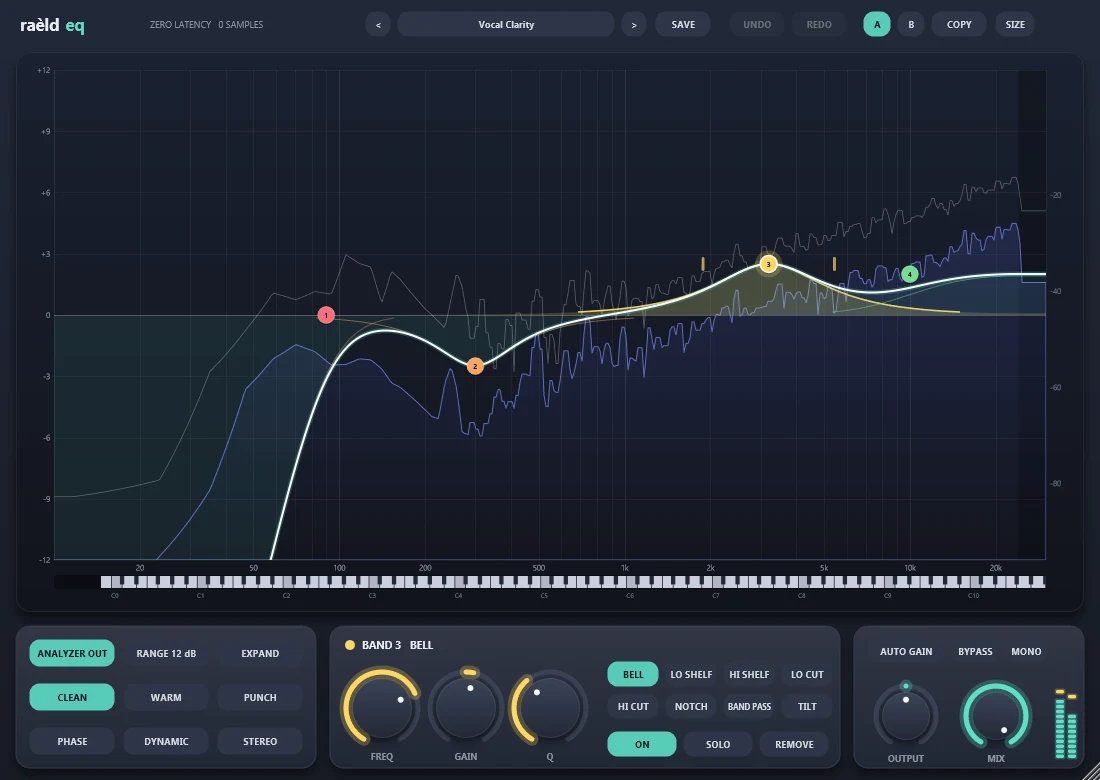
Everything happens on the curve
The display is the EQ. The knobs follow whatever band you pick, and the advanced panels stay out of the way until you need them.
Work right on the curve
Double-click to add a band (a low cut at the far left, a high cut at the far right, a bell anywhere else). Drag it, use the wheel or its edge handles for width, right-click for everything else, Alt-click to remove.
24 bands, eight types
Bell, low and high shelf, low and high cut from 6 to 96 dB per octave, notch, band pass and tilt. Gain ±30 dB, 10 Hz to 30 kHz, Q from 0.1 to 40. A cut is the exact inverse of the same boost.
True curves to the top
Each filter is fitted to its analog curve, so a bell at 15 kHz stays its proper shape: within 0.14 dB of analog at 44.1 kHz. The display draws the real curve, not an idealised one.
Three phase modes
ZERO LATENCY for tracking and live use. NATURAL for the analog curve and phase with 55 samples of delay. LINEAR for mastering, with no phase shift at all. Your DAW is told the latency and compensates.
Dynamic bands
Any bell or shelf can act only when its frequencies cross a THRESHOLD, with ATTACK and RELEASE: tame harshness or esses only when they happen. Past the threshold it moves 0.75 dB per dB, up to the band's gain.
Stereo, left, right, mid or side
Each band works where you put it: on both sides, one side, the centre or the sides. SOLO plays just the part a band works on, so you hear exactly what you're cutting. Plus an output PAN.
Analyzer, piano and peak grab
A real-time analyzer of the input and output behind the curve, and a piano along the bottom. Hover a band to read its note (A2 · 110 Hz). Hover a peak in the analyzer and drag: a narrow band lands right on it.
MIX, AUTO GAIN, OUTPUT
MIX scales the whole curve: at 50% every boost and cut is half as big. It never blends two signals, so it never comb-filters. AUTO GAIN keeps the loudness steady, so you judge the tone, not the volume.
Undo, redo and A/B
Up to 200 steps of undo, where one drag is one step. Two complete settings to compare, saved with your session. A saved session reloads bit for bit.
Clean, warm or punchy
Three keys in the first card under the curve choose how the EQ sounds. The colour comes only from bands that are doing something: with nothing active, the output is the input, bit for bit, in every character. Switching glides, so you can switch while the music plays. Each screenshot shows the Vocal Clarity preset.
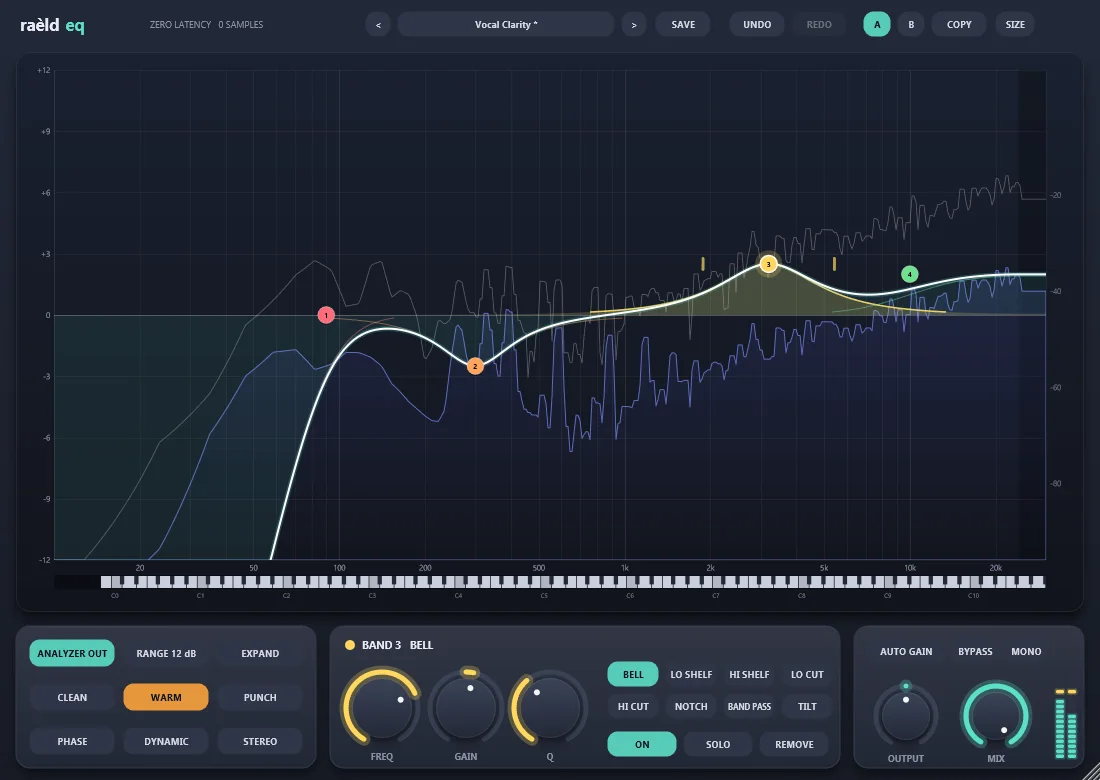
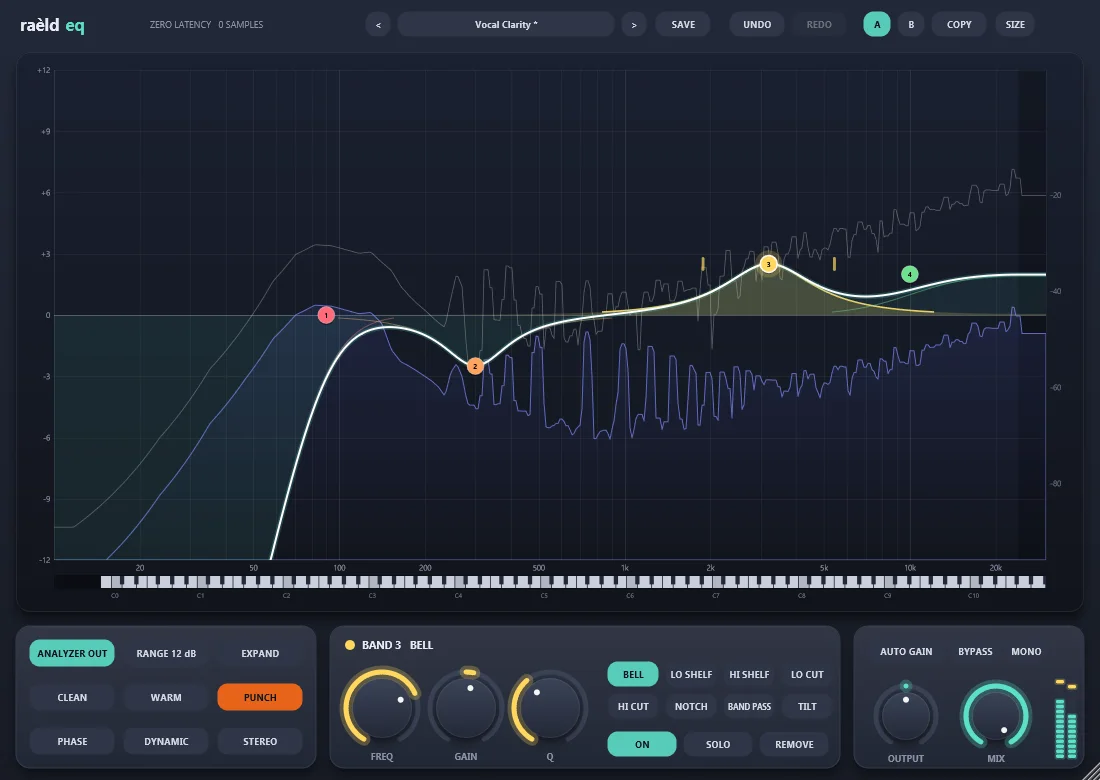
CLEAN · shown with the Vocal Clarity preset
The harmonics are made from a band-limited copy of the signal, so nothing folds back (a 15 kHz tone at −3 dBFS: the strongest other component is −113.6 dB) and there's no added latency. The characters are subtle: most of the difference you'll hear is how the bands narrow as you boost.
Soft, friendly, all curve
Raèld EQ has a face of its own: a deep blue-grey window where the curve takes most of the room, three soft cards floating under it (the view and character, the selected band, the output), soft dark knobs with a thick arc of light in the band's colour, and rounded keys that fill with colour when they're on. It opens small, at 726 × 515, and SIZE takes it from 85 to 300 % of that; it's remembered. Pick a view below.
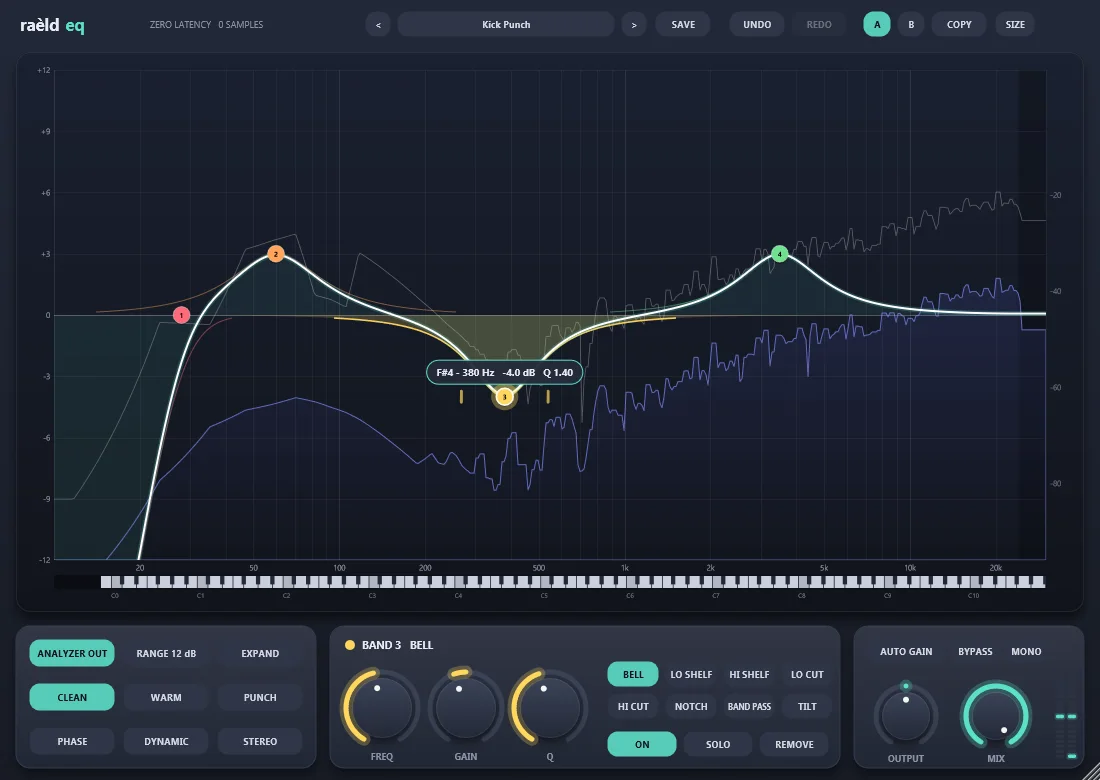
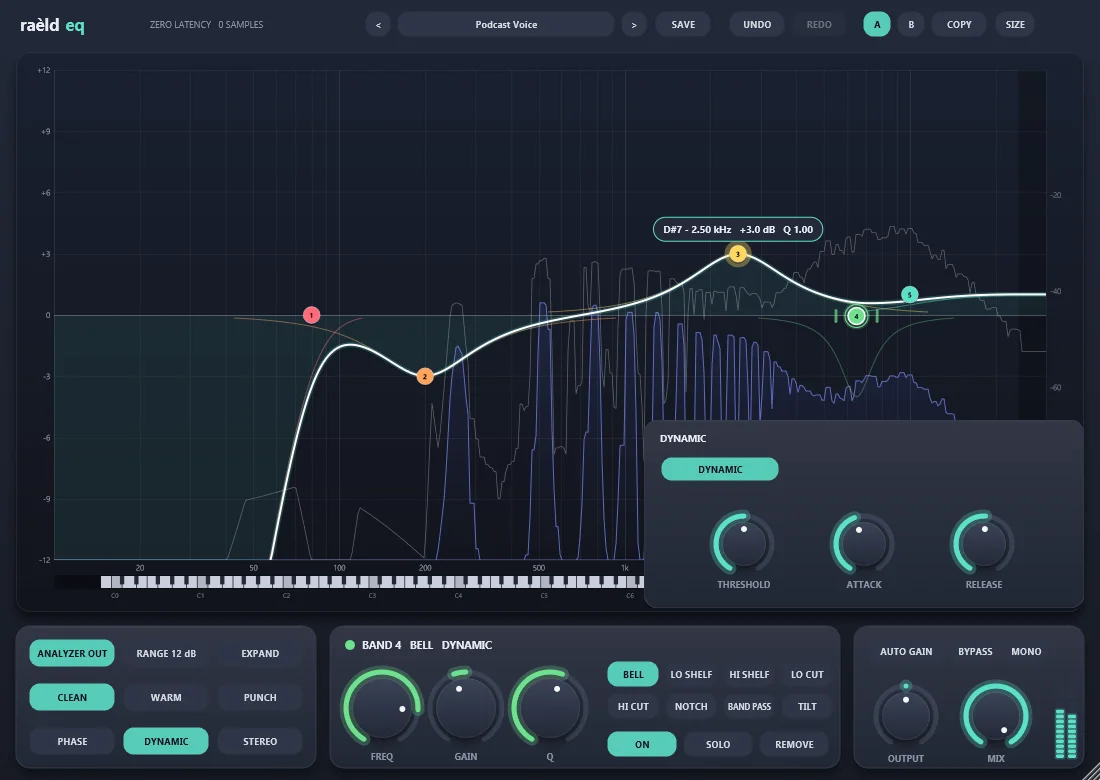
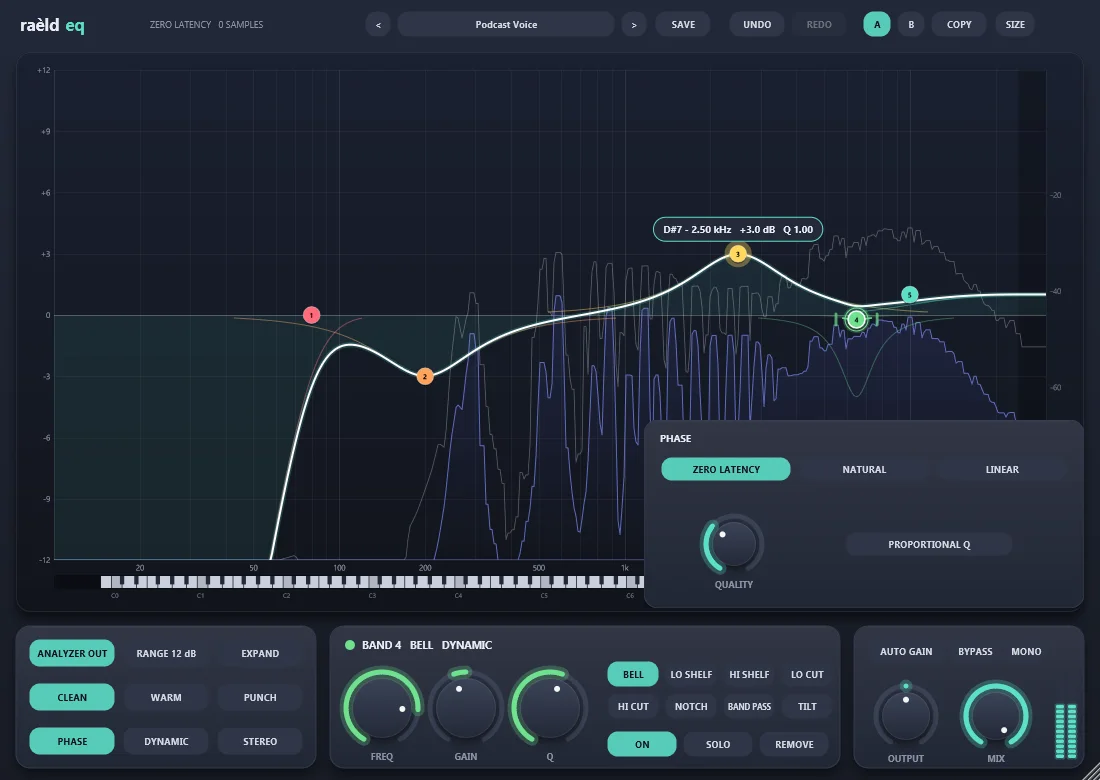
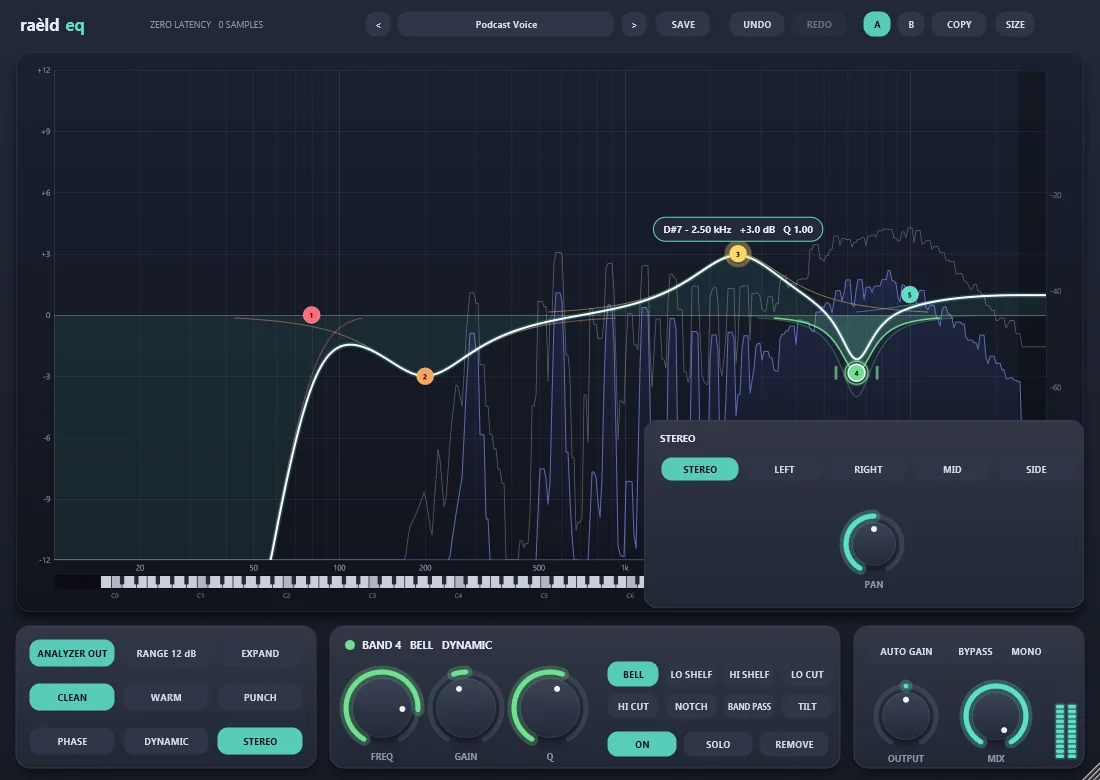
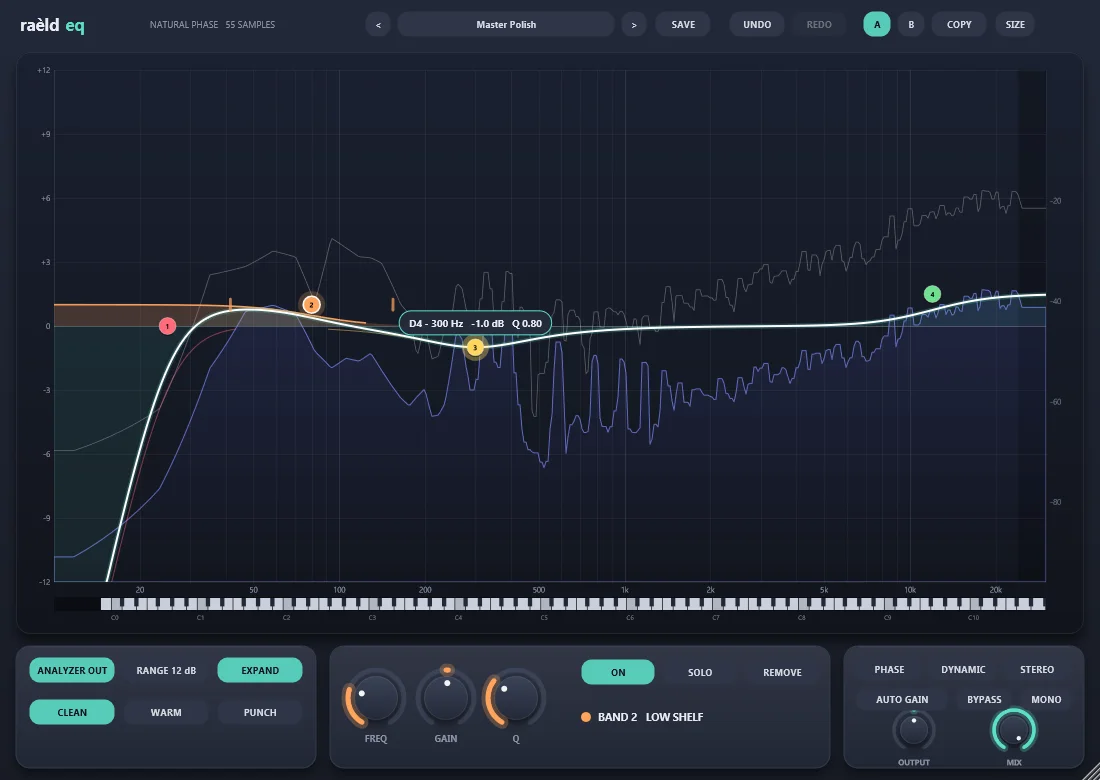
HOVER · a band's note, frequency, gain and Q
Pick the delay the job allows
| Mode | Latency at 44.1 / 48 kHz | Use it for |
|---|---|---|
| Zero Latency | 0 | Tracking, live, anything where delay matters. |
| Natural Phase | 55 samples (about 1.2 ms) | Mixing: the analog curve and phase right up to 20 kHz, with almost no delay. |
| Linear Phase | QUALITY Low 2560, Medium 4608, High 8704, Maximum 16896 samples | Mastering and parallel processing: no phase shift at all. |
Your DAW is told the latency and compensates for it. At 96 and 192 kHz the linear-phase filters grow with the rate, so their frequency resolution stays the same.
Simple on top, deep underneath
| Control | What it does |
|---|---|
| FREQ, GAIN, Q | The selected band (click a dot to select it). They and the display always move together. For a cut, GAIN becomes SLOPE (6 to 96 dB per octave) and Q sets the resonance at the corner. |
| Band type keys | Bell, Low Shelf, High Shelf, Low Cut, High Cut, Notch, Band Pass, Tilt. |
| ON, SOLO, REMOVE | Switch the selected band in or out; hear only what it works on; take it away. |
| CLEAN, WARM, PUNCH | The CHARACTER: transparent, or one of two colours. |
| PHASE | ZERO LATENCY, NATURAL or LINEAR; QUALITY for linear phase; PROPORTIONAL Q (bells narrow as you boost or cut further). |
| DYNAMIC | Makes the selected bell or shelf act only past its THRESHOLD, with ATTACK and RELEASE. |
| STEREO | Where the selected band works (stereo, left, right, mid or side), and the output PAN. |
| OUTPUT, MIX | Level after the EQ, ±30 dB; MIX scales the whole curve. |
| AUTO GAIN | Keeps the loudness the same while you EQ. |
| ANALYZER, RANGE, EXPAND | Analyzer off, output, or input and output with a peak hold; the display's range (6, 12, 18 or 30 dB); a taller curve, with slimmer cards under it. |
| UNDO, REDO, A, B, COPY | Step through your changes (Ctrl+Z, Ctrl+Y); two complete settings to compare. |
| BYPASS, MONO | BYPASS crossfades to the untouched input, latency-compensated. MONO folds the output to mono, to check the mix on a mono speaker; not saved in presets. |
Knobs: drag up or down (Shift for fine control), the wheel or the arrow keys; double-click resets; the value shows while you adjust and when you hover. Circular dragging is an option in the SIZE menu.
What we measured
| Test | Result |
|---|---|
| Bells against the analog curve, 20 Hz–20 kHz, Zero Latency, 44.1 kHz | within ~0.15 dB to 20 kHz: a +6 dB bell at 10 kHz 0.135 dB, at 15 kHz 0.138 dB, a +4 dB bell at 18 kHz 0.091 dB; a high shelf at 12 kHz 0.049 dB |
| The worst bell anywhere (10 Hz–20 kHz, Q 0.3–10, ±30 dB) | 0.48 dB at 44.1 kHz, 0.46 dB at 48 kHz, 0.26 dB at 96 kHz |
| Natural and Linear Phase against the analog curve | within 0.030 dB and 0.007 dB |
| Set flat, every phase mode and character, 44.1–192 kHz | bit-for-bit the input |
| A boost followed by the same cut | flat within 0.000001 dB |
| Latency, reported to your DAW | 0 / 55 samples / 2560 to 16896 samples (Linear, by QUALITY) |
| Fast sweeps of frequency, gain and Q | energy at the zipper-noise frequencies −107 to −136 dB |
| Dynamic band, threshold −30 dBFS, −9 dB range, a 3 kHz tone at −24 dBFS | −4.50 dB of cut (the rule says −4.5) |
| WARM / PUNCH, a +9 dB band, 200 Hz tone | WARM 0.13% THD at 0 VU, 0.36% at −6 dBFS peaks; PUNCH 0.11% and 0.48% |
| Switching CLEAN → PUNCH → WARM under a +9 dB tone | no click: the largest sample step equals the tone's own |
| CPU (stereo, 48 kHz, % of one core) | Zero Latency 0.2% (1 band), 0.5% (8), 1.2% (24); Natural 0.6 / 1.2 / 2.6%; Linear (Medium) 0.4% |
Measured by our test suite on test signals, at 0 VU = −18 dBFS. Your ears are the judge.
Eight presets for eight jobs
Each one is a starting point for a task, on just the bands it needs. Save your own with SAVE.
| Preset | What it's for |
|---|---|
| Vocal Clarity | Less rumble and boxiness, more presence and a little air for a lead vocal. |
| Kick Punch | Weight at the bottom, the cardboard taken out of the middle, and the beater's click. |
| Bass Tighten | A cleaner bottom: sub rumble out, low mids tidied, a touch of growl for definition. |
| Remove Mud | Takes the muddy build-up out of the low mids, cleanly. |
| Air & Shine | Open, airy top end without harshness. |
| Master Polish | Gentle final touches for a master, in Natural Phase. |
| Podcast Voice | Clear, full speech: rumble and boom out, presence in, esses kept in check by a dynamic band. |
| Tame Harshness | Dynamic cuts that only act when the upper mids get harsh. |
Plus Init: flat, no bands. Double-click the display to add one.
Own it, or get it with everything else
Raèld EQ
One-time payment. No subscription.
- VST3 plugin and standalone app
- One license for up to 3 of your computers
- Never expires, works offline 30 days at a time
- Download link and license key by email, instantly
Every Raèld plugin
or $99/year
- Raèld EQ plus every other Raèld plugin
- Every new plugin the day it's released
- One key for all of them, on 3 computers
- Cancel anytime
Secure checkout by Lemon Squeezy. Sales tax and VAT calculated at checkout.
Windows 10/11 (64-bit), VST3 and standalone. Download Raeld-EQ-2.0.0-Windows.zip; DAWs list it as "Raeld EQ", so type "raeld" to find it.
Good to know
Where do I start?
Pick the preset closest to your job, or Init. Double-click the display where you want a band, then drag its dot: left and right for frequency, up and down for gain. Use the wheel over the dot to make it narrower or wider. Turn on AUTO GAIN to compare with bypass at the same loudness.
Which phase mode should I use?
ZERO LATENCY while tracking or playing live. NATURAL for mixing: it follows the analog curve and phase right up to 20 kHz with only 55 samples of delay. LINEAR for mastering, or when the EQ'd track runs in parallel with an untouched copy, because it shifts no phase at all.
Which character should I use?
CLEAN when you only want the curve. WARM and PUNCH add a little colour from the bands that are doing something, and make bells narrow as you boost (gently on WARM, strongly on PUNCH). They're subtle; switch between them while the music plays and keep the one you like.
Does it add latency?
Not in ZERO LATENCY. NATURAL adds 55 samples at 44.1 or 48 kHz (about 1.2 ms); LINEAR from 2560 to 16896 samples, set by QUALITY. Your DAW is told and compensates automatically. CHARACTER never adds latency.
How is it different from Raèld Surgical EQ?
Raèld EQ is for shaping tone, with a CLEAN, WARM or PUNCH character. Surgical EQ is for taking problems out: FIND & FIX listens to your track and puts a precisely sized cut on each problem it finds.
Does it work on mono tracks?
Yes. It runs on mono, mono-to-stereo and stereo tracks, and your DAW picks automatically. On a mono-to-stereo track the mono source feeds both sides. On a mono track, bands set to Side do nothing, and Left, Right and Mid act on the one channel. The MONO button folds the output to mono, to check how the mix holds up on a mono speaker; it isn't saved in presets.
Can I try it first?
Yes. Without a key it runs as a full demo; the only limit is a short dropout every 45 seconds. Enter a Raèld EQ key or your All Access key any time to unlock it.
Read the Raèld EQ manual · Download · All support questions →
Raèld EQ is an original design and is not affiliated with or endorsed by any other manufacturer.